What Closing Costs Actually Look Like on an Austin Home Purchase Right Now
From Travis County recording fees to Texas's fixed title insurance rates, here's what to expect on your Closing Disclosure — and what's negotiable in today's market.

From Travis County recording fees to Texas’s fixed title insurance rates, here’s what to expect on your Closing Disclosure — and what’s negotiable in today’s market.
Budget roughly $9,500 to $15,000 in closing costs on a $450,000 Austin home purchase, not counting your down payment. Most buyers ask how much this will be too late — after they’ve already negotiated a purchase price and are staring at a Loan Estimate they don’t fully understand.
The national estimate you’ll see on most mortgage websites — “budget 2 to 5 percent of the purchase price” — is technically accurate and almost useless for planning. On a $450,000 purchase, that range spans $9,000 to $22,500. The actual Austin number lands tighter: 2.1 to 3.3 percent, or $9,500 to $15,000.
What drives the spread? Your specific transaction. Which lender you use. Whether you’re buying inside a Municipal Utility District. Whether your property has an HOA. How aggressively you negotiate seller concessions. And what your homeowners insurance actually costs in 2026, which is a very different conversation than it was three years ago.
One clarification before going line by line: closing costs and your down payment are two separate buckets that buyers routinely conflate. Your cash-to-close combines both. On a $450,000 purchase with a conventional 5 percent down payment ($22,500), your total cash-to-close might run $32,000 to $37,500. On 20 percent down ($90,000), it’s closer to $99,500 to $105,000. The down payment is fixed by your loan program. The closing costs have more flexibility, and that’s what this piece covers.
Texas Title Insurance Is Set by Law — Stop Trying to Shop the Premium
Texas is one of roughly eight states where the Department of Insurance sets title insurance premiums by formula. Every title company in Austin charges the identical owner’s policy premium for any given purchase price — whether it’s a boutique shop on South Congress or a national underwriter in a Cedar Park strip mall. There’s no competitive pricing on the premium itself.
For a $450,000 purchase, the Texas promulgated rate produces an owner’s title insurance premium of approximately $2,657. That figure comes from the Texas Department of Insurance’s tiered rate table. Buyers can verify the current schedule at tdi.texas.gov before closing.
When a lender’s policy is issued simultaneously at the same closing, it gets a simultaneous-issue discount that brings it down to roughly $100 to $200.
What you can actually shop is the title company’s settlement fee — also called the closing fee or escrow fee. This varies across Austin title companies and currently runs $450 to $750. The premium is fixed by law, but the settlement fee, and the service behind it, is where a real choice exists. Experience with specific transaction types matters more than most buyers realize. Condos in Mueller close differently than properties in a MUD district in Pflugerville. The owner’s title policy premium is also one of the line items where local custom affects who writes the check, which brings us to the next section.
Who Traditionally Pays for What in Austin
In Austin, it’s been the long-standing custom — not a legal requirement, but a strong market norm — for the seller to pay the owner’s title insurance premium. Nationally, this varies. In some states buyers cover it. In Travis County, sellers almost always have.
That custom is holding in 2026, but with more negotiation than during the 2021–2022 frenzy, when buyers were waiving every possible seller contribution just to get their offers accepted. Days-on-market have increased significantly since the peak, and buyers in most Austin submarkets have enough room to make reasonable requests. An East Austin condo that’s been sitting for three weeks is a very different negotiation than a move-up home in Steiner Ranch with multiple showings that weekend.
In new construction, builder incentive programs have been replacing traditional seller credits — but the net effect for buyers can be similar. Worth asking about explicitly rather than assuming the list price is the complete offer.
One distinction worth arguing about with your agent if they push back: seller concessions and price reductions are not the same thing. A $5,000 price reduction lowers your loan balance and reduces your monthly payment by a small amount. A $5,000 seller credit toward closing costs directly reduces what you bring to the table on closing day. For buyers who are cash-constrained, concessions matter more than price cuts.
Lender Fees — and What’s Actually Negotiable Right Now
The lender section of your Closing Disclosure contains fees that vary more than almost any other line item. Origination and underwriting fees at most Austin lenders currently run $995 to $1,500. The appraisal, which you pay out of pocket before closing (though it shows on your Closing Disclosure), is currently $550 to $750 in the Austin market — elevated from pre-2021 levels, a hangover from the refinance boom of 2020–2021 that hasn’t fully resolved. Credit report fees run $30 to $75.
Lender fees are more negotiable right now than they were during peak purchase years. With refinance volume still low and meaningful competition among lenders for purchase business, well-qualified borrowers have real room to push. Ask specifically whether your lender will waive or reduce the origination fee, or provide a closing cost credit in exchange for a marginally higher interest rate. Whether that trade makes sense depends on how long you plan to keep the loan — worth running the math with your loan officer rather than just accepting whatever lands in your inbox.
Get your Loan Estimate within three business days of submitting your loan application. This is your comparison document. Get estimates from at least two lenders before committing, and compare Section A (origination charges), Section B (services you cannot shop), and Section C (services you can shop) separately. Reading a Loan Estimate isn’t intuitive the first time. It gets easier fast.
Recording Fees, Survey Costs, and the MUD Tax Trap
The Travis County Clerk charges recording fees on a per-page basis: $25 for the first page, $4 for each additional. A warranty deed typically runs three to five pages ($33 to $41). A deed of trust commonly runs 15 to 25 pages ($81 to $121). Combined, expect roughly $114 to $162 in Travis County recording fees on a standard financed purchase — predictable, at least.
One Texas-specific item that actually saves buyers money: there is no statewide real estate transfer tax, and no local Travis County equivalent. In New York, Maryland, or Delaware, transfer taxes can add thousands of dollars to a closing. In Austin, that line simply doesn’t exist.
Survey costs depend on whether your lender or title company requires a current survey and whether the seller has one available to certify. A new survey runs $400 to $650 in Travis County. Many Austin sellers have a survey from their original purchase, and title companies will often accept a certified existing survey rather than requiring a new one — worth verifying early, not three days before closing.
The Municipal Utility District issue deserves more attention than it gets in most closing cost discussions. A large share of Austin-area growth over the past 20 years has occurred in MUD territory — far north Austin, Pflugerville, Hutto, Kyle, newer developments in Georgetown and Leander. Buying in a MUD means a required disclosure and, in some cases, a transfer fee that can add $150 to $400 to closing costs that no national estimator will flag for you. That’s the small problem. The larger one is ongoing: MUD districts levy their own property taxes to service infrastructure bonds, and those rates add meaningfully to your effective tax rate on top of base county and school district charges. If you’re comparing a property inside Austin city limits to one in a MUD district in Pflugerville, the tax comparison isn’t apples-to-apples. Run the actual numbers before you fall in love with the price tag.
Property Tax Prepaids: Your Zip Code Changes This Number Significantly
Texas collects property taxes in arrears — you pay 2025 taxes in January 2026. Lenders, however, want an escrow cushion established at closing. The standard calculation collects two to three months of estimated monthly taxes as a deposit, plus the prorated portion of the current year’s taxes from the closing date through year-end.
For a City of Austin property in Travis County served by Austin ISD, the 2024 combined property tax rate is approximately $1.6321 per $100 of assessed value. That combines the City of Austin’s rate of approximately $0.4167, AISD’s approximately $0.7392, Travis County’s approximately $0.3713, and smaller levies including Austin Community College at approximately $0.1049. Buyers should verify current certified rates with the Travis Central Appraisal District before closing, since rates are confirmed annually.
On a $450,000 assessed value, that combined rate produces an annual bill of approximately $7,344. At closing, your lender will collect an escrow deposit of two to three months of that annual amount — roughly $1,224 to $1,836.
That rate is specific to City of Austin/AISD/Travis County properties. Round Rock ISD, Leander ISD, and MUD overlays each produce materially different numbers. The difference is sometimes a deal-changing number — not a footnote.
The Texas homestead exemption, currently $100,000 off the school district’s assessed value for a primary residence, will reduce your ongoing tax bill once it takes effect. It does not reduce your first-year escrow deposit at closing. The lender calculates the escrow using the full assessed value until the exemption is confirmed by the appraisal district, typically the spring following your purchase. You’ll see an escrow adjustment letter after your first annual analysis once the exemption posts. That letter usually brings good news.
Homeowners Insurance Is Now the Fastest-Growing Line at the Closing Table
Three years ago, homeowners insurance was a closing cost Austin buyers barely thought about. Now it’s the line generating the most sticker shock, and the one worth understanding before you’re sitting at the closing table.
The math: you owe the full first-year premium before or at closing, and your lender collects an additional two months’ worth as the initial escrow deposit. Total insurance burden at closing is 14 months of premium, not 12. For a $450,000 home in Austin, expect $2,400 to $4,200 per year depending on location, construction age, roof material, proximity to wildfire-risk terrain in western Travis County, and which carriers are actually writing in your specific area. At 14 months, the total insurance prepaid at closing runs $2,800 to $4,900.
Austin sits in a hail corridor. Storm damage claims have pushed actuarial losses higher for carriers across the board. Wildfire risk in the western portions of the metro has increased costs for properties near vegetated terrain. Reinsurance markets have gotten more expensive nationally, and that cost flows directly to consumer premiums. None of this is unique to Austin, but it’s more pronounced here than in many comparable markets.
Buyers purchasing in hail-prone zip codes or near wildfire-risk terrain should get an insurance quote before removing inspection contingencies. The premium is material enough to affect affordability, and finding that out before you’re under contract is significantly better than finding out after. As we cover in our home & property coverage, understanding the full cost of ownership — not just the purchase price — is what separates buyers who close confidently from those who scramble at the end.
HOA Transfer Fees: What Condo Buyers Owe That Single-Family Buyers Don’t
Austin has a substantial HOA-governed housing stock. Mueller, Circle C Ranch, Steiner Ranch, Avery Ranch, most master-planned communities in Cedar Park, virtually all new construction subdivisions in the outer suburbs. If you’re buying in one of these communities, expect closing cost line items that national estimators won’t show you — and that some buyers encounter for the first time the evening before closing.
HOA transfer fees cover transferring the membership and account from seller to buyer. They’re charged by the HOA or its management company and typically run $100 to $300. The resale certificate — a document package disclosing the HOA’s financial health, pending assessments, and governing documents — is required by Texas law, with the cost ($200 to $400) often falling into the closing cost negotiation. Some sellers pay it; others pass it to the buyer.
Some HOAs also charge a capital contribution or working capital fee as a one-time contribution to the community’s reserves upon purchase — essentially an initiation charge that can run $100 to $500 or more depending on the community.
None of this is standardized. Request the fee schedule from the HOA during the option period, before the option expires. If the seller has prepaid annual HOA dues, you’ll see a credit back to the seller and a corresponding charge on your settlement statement. That’s separate from any fees charged by the management company — two different line items that sometimes get conflated.
The Complete Closing Cost Table for a $450,000 Austin Purchase
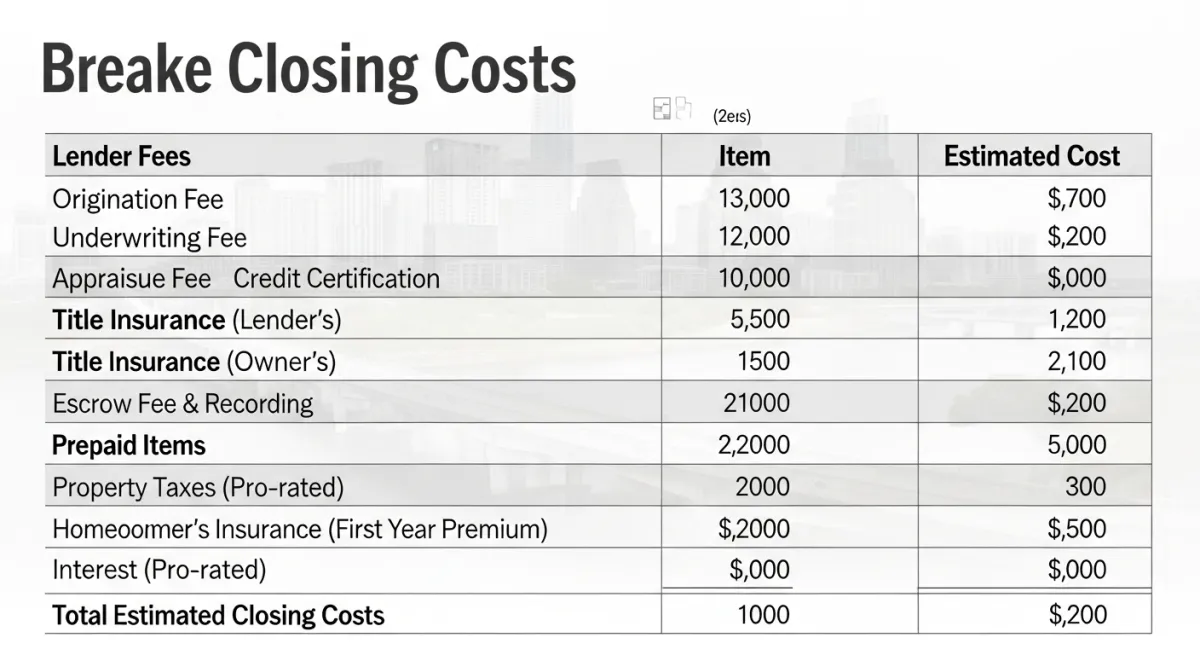
The following reflects a conventional loan transaction in Travis County on a City of Austin/AISD property with an HOA, based on local data and early-2026 market conditions. “Fixed” means the fee is set by law or third-party provider. “Lender-negotiable” means it can vary or be offset by a lender credit. “Seller-negotiable” means it’s customarily or practically available for seller concession. Verify all figures against your specific Loan Estimate.
| Line Item | Low Estimate | High Estimate | Status |
|---|---|---|---|
| Owner’s title insurance premium | $2,625 | $2,700 | Fixed (TDI promulgated rate) |
| Lender’s title insurance (simultaneous issue) | $100 | $200 | Fixed |
| Title settlement/closing fee | $450 | $750 | Negotiable (shop title companies) |
| Loan origination/underwriting fee | $995 | $1,500 | Lender-negotiable |
| Appraisal fee | $550 | $750 | Lender-negotiable |
| Credit report fee | $30 | $75 | Fixed |
| Travis County recording fees | $114 | $162 | Fixed |
| Survey (if required) | $0 | $650 | Fixed if required |
| Property tax escrow deposit (2–3 months) | $1,224 | $1,836 | Fixed (based on tax rate) |
| Property tax prepaid (closing date proration) | $200 | $800 | Fixed (depends on closing date) |
| Homeowners insurance – first-year premium | $2,400 | $4,200 | Shopped independently |
| Homeowners insurance escrow deposit (2 months) | $400 | $700 | Fixed (based on premium) |
| HOA transfer fee | $100 | $300 | Seller-negotiable |
| HOA resale certificate fee | $200 | $400 | Seller-negotiable |
| HOA capital contribution | $0 | $500 | Seller-negotiable |
| Prepaid interest (1–30 days) | $100 | $600 | Varies by closing date |
| Total | ~$9,500 | ~$15,000 |
This table doesn’t include mortgage discount points, which are an optional prepaid interest charge to buy down your rate and are separate from closing costs as described here. It also assumes no PMI escrow deposit, which would apply if your down payment is below 20 percent on a conventional loan and would add one to two months’ PMI premium to the escrow column. If you’re weighing which home improvements actually add resale value in Central Texas before listing or purchasing, the same discipline of running real numbers applies there too.
Three Things to Ask For Before You Close
Ask your lender for a credit. Early 2026 is a more favorable environment for borrowers to push on lender fees than 2022 was. Well-qualified buyers who don’t ask are leaving real money on the table. Ask specifically whether your lender will reduce the origination fee or provide a closing cost credit in exchange for a marginally higher rate. Get the Loan Estimate in writing. Compare it against at least one competitor before committing.
Ask the seller to cover owner’s title insurance and HOA fees. In Travis County, it’s customary for the seller to pay the owner’s title policy. If that’s not already in your purchase contract, it should be. On properties that have been sitting 30 or more days, a seller concession request of $4,000 to $6,000 toward closing costs is a reasonable ask in the current market. You may not get all of it. Ask anyway.
Read your Loan Estimate within three business days of application. Federal law requires your lender to provide it within three business days of your loan application. Read Section A (origination charges), Section B (services you cannot shop), and Section C (services you can shop) carefully. Compare it to what you were verbally quoted. Fees in Section A cannot increase at closing without a change of circumstance. Hold your lender to those numbers.
A Note on Austin Closing Logistics
Texas doesn’t require an attorney at closing. The title company handles it, which keeps closings straightforward. Most run 30 to 90 minutes. Standard Austin closing timelines for a financed purchase run 21 to 30 days from contract to close.
Your closing date within the month affects your prepaid interest charge. Closing on the first of the month maximizes it — you’re paying interest for nearly the entire month before your first payment kicks in. Closing on the 28th or 29th minimizes it. If you have any flexibility, closing toward the end of the month is an easy, low-effort way to reduce what you bring to the table.
The final Closing Disclosure must be provided at least three business days before closing. Compare it line by line to your Loan Estimate. Most fees in Section A cannot increase; others have a 10 percent tolerance. If a number has changed materially without explanation, ask before you sign — not after.