What the Ozone and Heat Data Say About Exercising Outdoors in Austin This Summer
TCEQ readings and heat index forecasts explain why the city's worst exercise days are worse than most runners realize

TCEQ readings and heat index forecasts explain why the city’s worst exercise days are worse than most runners realize
Most Austin runners have a summer heat strategy. Get out by 7 a.m. Carry water. Wear light colors. What far fewer have is an ozone strategy — and on Austin’s most dangerous summer days, that gap can genuinely hurt them.
Here’s what the data actually shows: Austin’s highest heat index days and its worst air quality days are almost always the same days. They’re driven by the same atmospheric conditions, and their effects on an exercising body compound rather than add. A runner on an Austin Ozone Action Day with a heat index of 108°F isn’t dealing with heat danger plus air quality inconvenience. They’re dealing with a feedback loop that can cut lung function by up to 20 percent at precisely the moment their cardiovascular system is working hardest to manage core temperature.
This piece covers both hazards together, with specific local numbers, specific local trails, and a specific decision framework. Not another roundup of generic summer fitness tips.
The Heat Index Numbers, and What They Mean When You’re Moving
The heat index accounts for how humidity prevents sweat from evaporating. The higher the humidity, the less efficiently you cool yourself, and the faster your core temperature climbs under a given workload.
The CDC and NOAA divide the heat index into four zones. Below 91°F is generally safe for healthy adults taking standard precautions. From 91°F to 103°F — caution territory — fatigue is possible with prolonged exposure. At 103°F, heat cramps and heat exhaustion become likely with physical activity. Above 124°F, heatstroke is imminent. The National Weather Service Austin/San Antonio office issues a heat advisory when the forecast heat index is expected to hit 105°F for two or more consecutive hours. In Austin’s July and August, that threshold is routine. Boringly, uncomfortably routine.
Austin’s humidity surprises people who moved here from Houston expecting similar air. Austin isn’t as persistently humid as the Gulf Coast, but it’s not dry either. On a typical July afternoon, relative humidity runs around 35 to 55 percent — enough to significantly impair evaporative cooling without the saturated, muggy feel that signals danger to anyone who’s spent a summer in Houston. That moderate humidity produces heat index readings of 105 to 115°F on peak days, without the sensory warning system that comes with oppressive moisture. You don’t feel as bad as you should. That’s exactly the problem.
By mid-July, Gulf moisture pushes overnight humidity substantially higher. A 60-minute run starting at 6:30 a.m. in late July is not the same run as in early June, even if the thermometer reads similarly. The overnight low drops less, morning humidity is elevated, and the body’s cooling capacity is compromised before you’ve covered a mile. This shift catches runners every year. The calendar says summer, but the physiology says the risk profile has changed.
What actually matters physiologically is core temperature, not the number on your phone. Normal core temperature is around 98.6°F. During hard outdoor exercise in extreme heat, core temperature can rise roughly 1°C every five to eight minutes without adequate cooling. Heat exhaustion symptoms — heavy sweating, weakness, nausea, confusion — typically appear when core temperature climbs above 102 to 104°F. At 104°F, cognitive function starts to deteriorate. At 106°F, organ damage risk escalates. Heat stroke begins at that 104°F threshold with central nervous system dysfunction. The math moves faster than most people expect, and it doesn’t wait for you to notice.
Why Non-Asthmatic Runners Should Take Ozone Action Days Seriously
Most coverage of Ozone Action Days in Austin focuses on sensitive populations: children, the elderly, people with asthma or COPD. That framing has given a lot of healthy adult runners permission to treat OADs as someone else’s problem. EPA research says otherwise, and the gap between public messaging and the actual science here is worth being genuinely annoyed about.
A TCEQ Ozone Action Day is issued when the forecast 8-hour average ozone concentration is expected to approach or exceed 70 parts per billion — the current National Ambient Air Quality Standard. The Austin-Round Rock area carries a nonattainment designation for ground-level ozone, meaning it has measured air quality that fails federal health standards. Austin isn’t starting from clean air and occasionally getting worse. It’s managing an ongoing air quality deficit.
EPA research documents FEV1 reductions — decreases in forced expiratory volume, the standard measure of lung function — of 5 to 20 percent in healthy, non-asthmatic adults during moderate to hard exercise at ozone levels between 70 and 80 ppb. These reductions come with airway inflammation, coughing, chest tightness, and reduced lung capacity. In people with no prior respiratory history. No diagnosis required.
Runners specifically need to understand the dose mechanism. Someone walking at a normal pace inhales a certain volume of ambient air per minute. A runner at hard effort inhales roughly 10 to 20 times that volume. Every breath pulls ozone deeper into the respiratory tract, and at high exercise intensity, the rate at which ozone reaches bronchial and alveolar tissue is dramatically higher than at rest. On a 75 ppb day — a moderate OAD — a runner finishing a one-hour workout has absorbed an ozone dose a seated office worker wouldn’t accumulate over a full workday. Keep that in mind the next time you’re grinding out miles at Town Lake while your colleagues sit in air conditioning.
TCEQ data shows that OADs in the Austin-Round Rock area cluster heavily in the June through September window. Austin’s ozone season runs April through October, and continued population growth means vehicle emissions — a primary source of the nitrogen oxides that drive ozone formation — are increasing. The current season’s running OAD count is posted at the TCEQ air quality forecast page, updated daily. As part of our health & wellness coverage, we track how Austin’s air quality patterns affect everyday residents.
When Ozone Peaks — and Why Morning Is the Only Real Window
Ozone isn’t directly emitted from a tailpipe or smokestack. It forms through a photochemical reaction: sunlight drives a chain of reactions between nitrogen oxides from vehicle exhaust and volatile organic compounds from vehicles, industrial sources, vegetation, and fuel vapors. Without sunlight, ozone doesn’t build.
That chemistry determines its daily cycle. Overnight, ozone dissipates through reactions with other compounds, particularly nitric oxide. By early morning — before the day’s traffic has loaded the atmosphere with nitrogen oxides and before sunlight has driven much photochemical reaction — ozone concentrations are at their daily minimum. Austin monitoring data consistently shows 6 to 9 a.m. as the lowest ozone window of the day. Early morning running isn’t just a heat strategy. It’s your best air quality window, too.
The TCEQ operates monitoring stations around the Austin area, including sites in Audubon Hills in northeast Austin and near the Waller Creek corridor. These capture the afternoon ozone peak, which in Austin typically runs from 2 p.m. to 7 p.m. as photochemical reactions accumulate through the afternoon traffic and solar heating cycle.
Check the TCEQ air quality forecast the evening before your planned run. Not the morning of. TCEQ issues its next-day forecast the prior afternoon. If an OAD is expected, you can know before you go to bed. Checking at 5:45 a.m. when you’re already lacing up is too late to make a real decision.
Why Austin’s Hottest Days Are Almost Always Its Worst Air Days
The reinforcing relationship between extreme heat and elevated ozone isn’t a coincidence. It’s a direct atmospheric consequence of the same conditions driving both.
The pattern that produces Austin’s worst summer days is a stagnant high-pressure dome sitting over Texas. It creates intense solar heating, suppressed winds, minimal cloud cover, and the kind of atmospheric stability that traps air at low altitudes. Those are precisely the conditions that maximize ozone formation and concentration. The same forecast that produces a NWS heat advisory is, in meteorological terms, a perfect ozone production forecast. The two problems don’t just coexist on bad days — they come from the same machine.
This means checking only one condition is structurally incomplete risk assessment. A runner who monitors heat index carefully but ignores TCEQ forecasts is reading half the relevant information on the days when it matters most.
On top of thermal stress and ozone, there’s radiant heat load. UT Austin climate research and Austin’s Climate Equity Plan both document that paved and exposed surfaces run 8 to 12°F hotter than shaded creek corridor microclimates. That’s not the heat index. That’s infrared radiation from pavement, caliche, and exposed limestone hitting your body directly. Shaded canyon corridors like the main Barton Creek Greenbelt offer measurably different thermal conditions — not just a psychological break. There’s a reason Barton Creek feels like a different city in July.
Austin Trails: Shade, Timing, and What the Popular Routes Don’t Tell You
Not all Austin trails are equivalent on high-risk days. The shade and topography differences are large enough to matter meaningfully before 8 a.m. After 9:30 or 10 a.m. on a high heat-index day, those differences essentially vanish. Trail selection matters a lot less than trail avoidance.
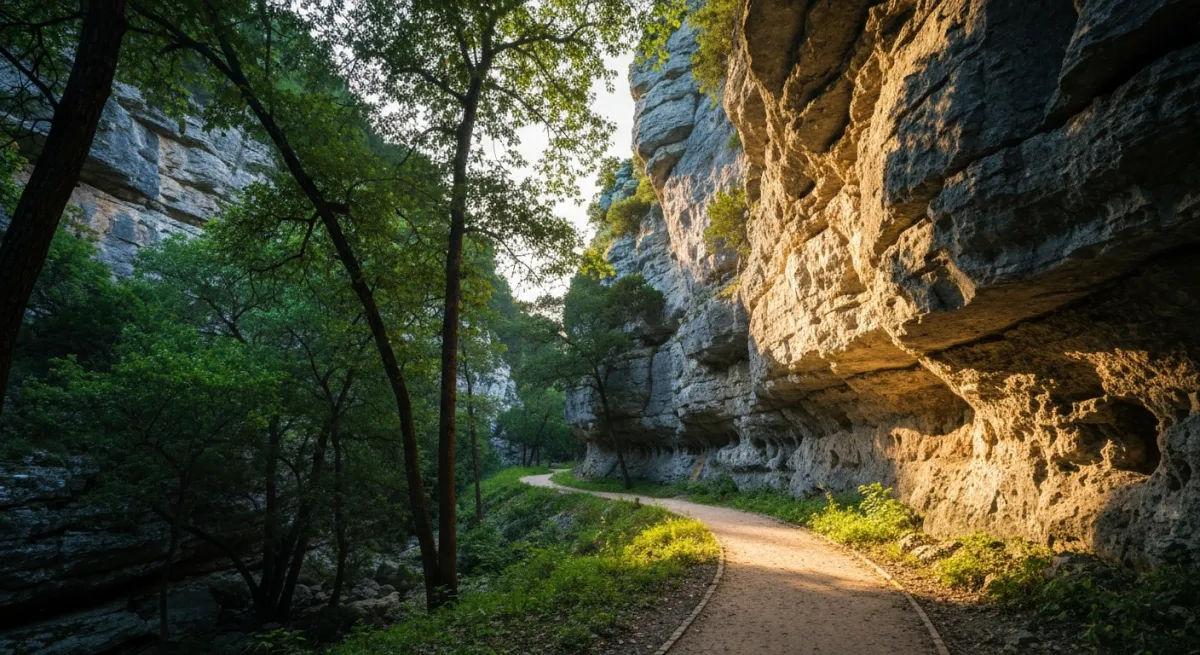
The Barton Creek Greenbelt is the most defensible choice for early morning exercise on marginal days. The main trail system descends into a limestone canyon corridor with cedar elm, sycamore, and live oak along the creek. The canyon walls and dense vegetation create a microclimate that is measurably cooler than surrounding neighborhoods, and the creek offers cooling access points. Confirm current access hours and drought closure status with Austin Parks & Recreation before heading out — closures are posted at the city website and through Austin311. The upper plateau sections above the canyon have substantially less shade than the canyon floor, which matters when you’re picking your access point.
Shoal Creek Trail runs roughly north-south through central Austin. Its tree canopy along the creek channel provides meaningful shade in the early morning, before the sun climbs high enough to reach the trail floor. It’s not as topographically insulated as the Greenbelt, but it’s far more accessible from central neighborhoods and dramatically better than street running. If you’ve ever tried a summer tempo run on Lamar Boulevard, you understand immediately.
Bull Creek District Park in northwest Austin has some of the densest canopy in the city — cedar, live oak, and elm along a protected creek corridor. Consistently cooler than exposed trails, best before 8 a.m. Verify current park hours with Austin Parks & Recreation at 512-974-6700.
Barton Springs Pool earns a specific mention. The spring-fed water sits at 68°F year-round, which measurably moderates the ambient microclimate immediately adjacent to the pool, and swimming laps there sidesteps both trail heat and ozone exposure entirely. Verify current 2025 hours directly with Austin Parks & Recreation. General admission is $5; Austin residents pay $3 after 8 p.m. Honestly, it’s a better morning than most runs anyway.
The Ann and Roy Butler Hike-and-Bike Trail around Lady Bird Lake is Austin’s most-used trail and among the least appropriate for exercise on high-risk days. The trail is heavily exposed along both shores, with limited canopy for most of its length and high radiant heat load from paved surfaces by mid-morning. A 5:30 or 6 a.m. start in July isn’t conservative caution — it’s minimum prudence. Going out at 8 a.m. because the sun “isn’t that high yet” is how people end up sitting on a bench near the Pfluger Bridge waiting for someone to bring them water.
The Veloway, the paved loop in Slaughter Creek Metropolitan Park, is entirely exposed with no shade to speak of. It’s a quality cycling and skating facility. It becomes unsafe for running after about 7 a.m. on high heat-index days. The same goes for the open sections of McKinney Falls State Park, where the waterfall areas offer some shade but much of the trail system is exposed cedar savanna and limestone.
One practical habit: Barton Creek Greenbelt is subject to drought-related closures when fire risk is high. Checking trail status the evening before — when you’re already checking the TCEQ forecast — is a two-step check that takes one minute. Do it at the same time. Done.
A Decision Framework for Each Morning
Two data points. Heat index forecast for midday and early afternoon from weather.gov or the NWS Austin/San Antonio office. TCEQ air quality forecast for the Austin area from TCEQ.texas.gov or the AirNow app. Get both the evening before.
Go, with standard precautions. Heat index below 103°F and no Ozone Action Day. Start by 7:30 a.m. if you prefer shade and lower humidity. Carry water. The risk is manageable for healthy adults.
Modify significantly, or don’t go. Heat index of 103 to 110°F, or an OAD designation, or both together. If you proceed outdoors: shaded trail only — Greenbelt canyon, Shoal Creek corridor, Bull Creek — start by 6:30 a.m., cut duration to 45 minutes or less, reduce intensity, bring more water than you think you need. The modification has to be real. This isn’t a green day with an asterisk.
Stay indoors. Heat index above 110°F and an OAD forecast. This is Austin’s high-risk scenario, where lung function impairment from ozone occurs simultaneously with dangerous thermal stress. No shaded trail fully compensates for a 112°F heat index. This is an indoor day or a rest day — not the overcautious call, the rational one. A missed training day is recoverable. Heat stroke is not.
If you’re out and notice early symptoms — unusual fatigue, headache, stopped sweating despite the heat, nausea, confusion — find shade immediately, contact someone, and get to a cooled environment. Don’t walk it off.
The Indoor Option Is Not a Retreat
Austin’s City of Austin Recreation Centers charge $3 for a daily drop-in visit for city residents, with monthly memberships around $30. Climate-controlled gyms, indoor tracks, pools. Three dollars. YMCA of Austin locations run roughly $50 to $60 per month for a standard adult membership, with some locations offering drop-in rates.
On a day when the heat index is forecast above 110°F and an OAD is posted, Barton Springs Pool or a $3 rec center visit isn’t a consolation prize. It’s the move.
The Short Version
Running before 7 a.m. on days without an Ozone Action Day forecast and a heat index below 103°F is manageable for healthy adults who take heat precautions seriously. Running after 9 a.m. in July or August without knowing that day’s heat index and ozone forecast means taking a combined risk most Austin runners aren’t fully aware they’re accepting.
Check two things the night before: the NWS heat index forecast and the TCEQ air quality forecast. Pick your trail based on shade, not habit. Know the difference between a day that requires modification and a day that requires you to stay inside. Austin’s summer is long, and the window of genuinely safe morning conditions shrinks significantly between June and the peak of August humidity. Runners who get through the summer healthy are the ones who work around the city’s atmospheric conditions rather than ignoring them. The ones who don’t are the ones posting about the “weird summer cold” that keeps coming back.