Which Austin ZIP Codes Have the Fewest Primary Care Doctors Accepting New Patients
HRSA shortage designations, insurance barriers, and a strained FQHC network leave ZIP codes like 78744 and 78741 with few real options for finding a primary care physician

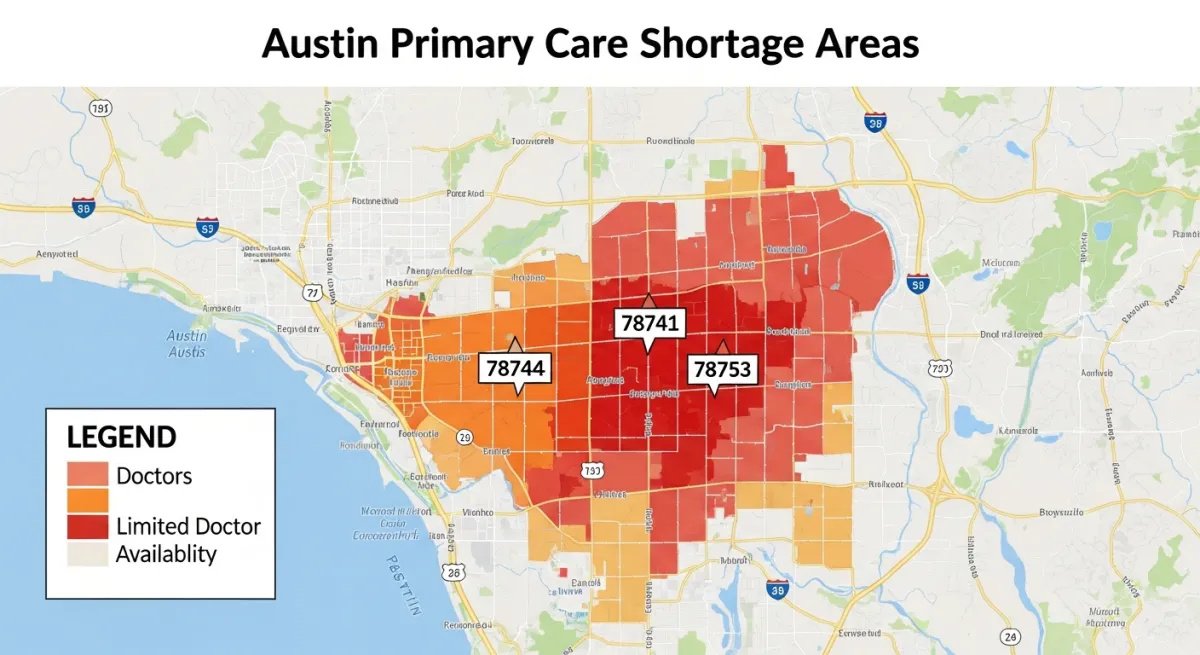
HRSA shortage designations, insurance barriers, and a strained FQHC network leave ZIP codes like 78744 and 78741 with few real options for finding a primary care physician
A resident in 78744 — Southeast Austin, along the growth corridor south of Slaughter Lane — needs a primary care doctor. She has Medicaid through CHIP for her children. Her own coverage is the Central Health MAP program, the county’s healthcare district benefit for adults who are uninsured and fall below an income threshold. Her nearest realistic option is CommUnity Care’s Southeast Health and Wellness Center on Frontier Valley Drive. Getting there isn’t easy. She has a persistent cough and no way to take time off work for multiple appointments.
Ten miles west, in 78746, a resident with a Blue Cross commercial plan books a same-week appointment. He picks from several concierge-adjacent internal medicine practices clustered near MoPac and Bee Caves Road. He does this online in under four minutes.
This isn’t a story about two unlucky individuals. It’s a structural feature of Travis County’s primary care system, documented in federal Health Professional Shortage Area designations, in Travis County’s own Community Health Assessment data, in provider-directory counts, and in HRSA’s publicly searchable database. The shortage is mapped. The affected corridors are named. And they’re worsening because Austin’s population growth over the past decade has been fastest in exactly the ZIP codes where the physician supply is thinnest. That last part deserves more attention than it gets.
What the Federal Data Actually Shows
HRSA — the Health Resources and Services Administration, the federal agency that funds safety-net health infrastructure — designates certain geographic areas as Health Professional Shortage Areas for primary medical care. These HPSA designations carry real weight. They’re calculated scores on a 0-to-25 scale, weighting the population-to-provider ratio, the poverty rate of the affected population, and distance to the nearest available care. A score above 14 triggers eligibility for the National Health Service Corps loan repayment program, one of the most concrete federal levers available for attracting physicians to underserved communities.
Several census tracts within Travis County’s eastern and southeastern corridors currently carry primary medical care HPSA designations. The geography clusters in ZIP codes 78741 (East Riverside and Montopolis), 78744 (Southeast Austin), 78753 (Rundberg and Georgian Acres), and portions of 78702 (Central East Austin). The census tract covering much of 78719 — the industrial stretch south of Austin-Bergstrom International Airport — shows a combination of poverty, geographic isolation, and near-zero physician presence. HRSA’s data explorer shows these designations have persisted across multiple designation cycles. This is not new. It hasn’t been new for a long time.
Compare that with the physician clustering visible in 78701 (Downtown and Clarksville), 78731 (Northwest Hills, Bull Creek), and 78746. Those ZIP codes don’t have HPSA designations. They have waiting rooms. Online booking. Same-week availability. The 10-mile figure in this headline isn’t approximate — it’s roughly the driving distance between CommUnity Care’s Southeast clinic and the nearest multi-physician internal medicine practice in Westlake that’s actually accepting new patients.
Neighborhood by Neighborhood: What Low Access Looks Like on the Ground
78744 was Austin’s fastest-growing ZIP code by population between 2015 and 2023. Apartment construction along East William Cannon and Slaughter Lane drove the growth, alongside families pushed out of more expensive East Austin neighborhoods by rising rents. The infrastructure — roads, schools, transit, health care — hasn’t kept pace. (If you’ve driven East William Cannon lately, none of this will surprise you.) Texas Medicaid eligibility for non-pregnant adults without disabilities is among the most restrictive in the country. A family in 78744 may have their children covered through CHIP and CommUnity Care while the adults have no coverage and no regular physician. The Travis County Community Health Assessment’s 2022–2023 cycle identifies 78744 as one of the corridors with disproportionately high rates of residents who report no usual source of care — the standard public health proxy for absent primary care access, and about as stark an indicator as that data produces.
78741 sits directly east of South Congress, one of Austin’s most intensively developed commercial corridors, and has no hospital within its boundaries. St. David’s South Austin Medical Center lies roughly three miles away, but hospital proximity is not the same as having a primary care relationship — a distinction that matters enormously once you have a chronic condition that needs managing between crises rather than only during them. The ZIP code has high renter density, a large Latino population, and significant residential churn as gentrification pressure pushes further east and south. Language access compounds the problem. A resident who speaks primarily Spanish needs not just a physician accepting new Medicaid patients but one with Spanish-language capacity. That narrows the available pool considerably.
78753 — North Rundberg and Georgian Acres — concentrates poverty at rates among the highest in the county. The immigrant population here is substantial, including residents with mixed immigration status within households. This creates a specific and cruel dynamic: CommUnity Care clinics in the area are open to anyone regardless of immigration status — federal FQHC rules require it — but fear of accessing government-adjacent services in the current federal enforcement environment is a documented deterrent. The clinic that’s legally required to serve you regardless of status becomes, for some people, exactly the kind of place they avoid. Language and trust barriers compound the raw physician shortage.
78702, Central East Austin, has undergone rapid gentrification over the past 15 years. Lower-income residents displaced east and south lost proximity to safety-net clinics that were once walkable or reachable by bus. The safety-net capacity that remains in 78702 — CommUnity Care has two sites within or adjacent to this ZIP — now serves both legacy low-income patients and a more commercially insured population that moved in recently. The ZIP codes east and southeast of I-35 post the worst rates on the county’s most telling metric: residents reporting no usual source of care. That measure predicts worse outcomes on virtually every chronic disease indicator — hypertension, diabetes, asthma — that public health tracks.
The Insurance Filter: Two Different Problems Inside One “Access Gap”
Most tools that purport to help residents find primary care treat the access question as a simple supply problem. Here are the physicians in your area. Pick one. That framing conceals a two-layer problem that differs sharply depending on what insurance you carry.
Commercially insured patients in shortage ZIP codes face the same frustrations as commercially insured patients in many American cities — long waits, practices not accepting new patients, geographic distance to available providers. It’s real, but it’s a quantitative problem. More distance, more wait, more difficulty. Eventually the system admits them.
Medicaid and uninsured patients face something categorically different. A significant share of Travis County’s primary care physicians don’t accept new Medicaid patients. This isn’t hidden — it’s visible in any methodical call-around of provider directories. But access analyses that look only at raw physician-to-population ratios systematically miss it. Filter the physician pool to providers who are accepting new patients and accepting Medicaid, and the available pool in eastern and southeastern Travis County shrinks to a fraction of what directory listings suggest. CommUnity Care isn’t the last resort for Medicaid patients in these ZIP codes. It’s the only one, for most people, most of the time.
The Texas-specific driver here is Medicaid non-expansion. Texas is one of a shrinking handful of states that hasn’t expanded Medicaid under the Affordable Care Act. The result is a coverage gap: adults who earn too much to qualify under current restrictive eligibility rules but too little to afford subsidized marketplace plans. That population is concentrated in the low-wage, high-rent demographics of eastern and southeastern Travis County. These residents aren’t Medicaid patients. They’re uninsured.
Travis County’s coverage gap affects tens of thousands of residents, according to county health planning documents. For this population, Central Health’s MAP program — the Medical Access Program, funded through the Travis County Healthcare District property tax — is the designed local solution. MAP provides a limited primary care benefit to qualifying Travis County residents who are uninsured and below a certain income threshold, routing patients primarily to CommUnity Care. That design has real value, but hard edges. MAP is a Travis County tax district benefit. A resident of Manor, in Travis County’s eastern unincorporated fringe, or of the Pflugerville suburban area that spills into Williamson County, may not qualify or may face access complications. That’s a geography problem dressed up as an eligibility problem.
CommUnity Care: The Network Holding the Safety Net Together
CommUnity Care is Austin’s primary Federally Qualified Health Center network. FQHC status, granted by HRSA, carries specific obligations and specific benefits. FQHCs must serve all patients regardless of ability to pay, accept Medicaid, CHIP, and Medicare, and offer a sliding-scale fee tied to federal poverty level guidelines for uninsured patients. In exchange, they receive higher Medicaid reimbursement rates and eligibility for federal grant funding. For uninsured patients in shortage ZIP codes, the sliding-scale fee structure at CommUnity Care — applied up to 200% of the federal poverty level — is the only realistic pathway to primary care that doesn’t run through an emergency department.
CommUnity Care’s Austin-area clinic footprint includes: St. John Community Health Center (78752, North Austin near Cameron Road); Rundberg Health Center (78753, directly serving the North Rundberg corridor); East Austin Health Center (near 78702); Southeast Health and Wellness Center on Frontier Valley Drive (78744, the anchor facility for the southeast corridor); Rosewood-Zaragosa Neighborhood Center (78702); Hancock Health Center (78751); a Pflugerville clinic serving the northeastern suburban zone; and a Cedar Park satellite serving the northwest growth corridor. Several sites provide dental and behavioral health as well, which matters because primary care in shortage areas frequently involves unmanaged chronic conditions with behavioral health components that can’t be cleanly separated from the rest of the picture.
CommUnity Care has publicly cited ongoing challenges recruiting primary care physicians willing to work in an FQHC setting, where compensation is lower than private practice and patient complexity is higher. That’s Austin’s cost of living colliding with a national primary care workforce shortage. The practical effect is constrained capacity to absorb population growth in 78744 specifically — which is exactly where capacity pressure is greatest.
A central question the available data raises, and that CommUnity Care hasn’t fully answered publicly, is whether provider capacity and hours at the Southeast clinic are growing at anything close to the rate Austin’s southeast corridor is adding residents. That clinic serves the largest growing population in the coverage area. Residents trying to reach CommUnity Care should call central scheduling at (512) 978-9015. Walk-in capacity exists at several sites but isn’t a reliable strategy for managing an ongoing chronic condition — you need an appointment, not just a slot.
Dell Medical School: A Community Health Mission, Measured Against Reality
Dell Medical School opened on the UT Austin campus in 2016 with an explicit goal of addressing Travis County’s health needs. The county funded the school’s launch in part through a property tax election that embedded community health access into the school’s founding structure. It was, at the time, a genuine statement of intent.
Eight-plus years in, the record is genuinely mixed — and not in the diplomatic, both-sides sense. Dell Medical School and UT Health Austin have expanded clinic infrastructure meaningfully, with a growing multispecialty presence around the 38th Street and Medical Parkway corridor in 78705. UT Health Austin has developed some primary care capacity. But its patient population skews commercially insured, and its clinic locations aren’t in the shortage-designated census tracts of 78744 or 78753. The people the school was partly funded to reach aren’t its primary clientele.
Dell Medical School’s Department of Population Health has produced research on Travis County health disparities, including neighborhood-level analyses of how social determinants compound physician shortage effects. The department runs residency programs, and some primary care residents rotate through CommUnity Care sites — providing clinical support to the FQHC network and, at least in theory, building a pipeline of future providers willing to practice in shortage areas. But whether Dell residency graduates actually remain in Travis County safety-net practice, versus leaving for higher-compensation settings, isn’t well-documented publicly. That’s a question worth pressing. Dell’s Department of Population Health didn’t respond to a request for comment by publication time. Given that faculty research has consistently identified geographic maldistribution of Travis County primary care as a persistent structural problem, the silence feels like a missed opportunity.
The contrast between UT Health Austin’s footprint and CommUnity Care’s footprint is the clearest illustration available of two different mandates. Expanding a health system is not the same thing as filling a safety-net gap. Both matter. They’re not interchangeable.
For Residents Trying to Find a Doctor Right Now
If you have commercial insurance and live in 78744, 78741, or 78753, call your insurer’s member services line. Request a list of in-network PCPs accepting new patients, filtered to Travis County ZIP codes east of I-35. Online directories are frequently outdated on new-patient status — this cannot be stressed enough. Call the office directly and ask two things: are they accepting new patients, and what’s the wait for a first appointment. That’s the only reliable method. Waits in these ZIP codes run substantially longer than in the western parts of the county.
If you have Medicaid or CHIP, CommUnity Care is your primary realistic option in East and Southeast Austin. The network accepts both programs at all of its sites. The most relevant for residents in shortage-heavy ZIP codes: Southeast Health and Wellness on Frontier Valley Drive (78744), Rundberg Health Center (78753), and East Austin Health Center (78702). Central scheduling: (512) 978-9015. Expect a new-patient wait. Show up for the appointment. Slot availability at safety-net clinics is limited and cancellations ripple through the schedule in ways that are hard to recover from.
If you are uninsured, CommUnity Care’s sliding-scale fee is based on your household income relative to the federal poverty level, applied up to 200% of that threshold. You don’t need to show documentation of immigration status. You will need proof of income to establish your sliding-scale rate. If you’re a Travis County resident and think you might qualify for Central Health’s MAP program — which provides a somewhat broader benefit package — you can apply at centralhealth.net. MAP eligibility is income-based and requires Travis County residency; it doesn’t cover residents in portions of far eastern Travis County that fall within Williamson County.
On telehealth: it handles some things well. Prescription refills for stable conditions. Mental health therapy. Minor acute complaints with clear presentations. It cannot replace an ongoing primary care relationship for patients with poorly controlled diabetes, moderate-to-severe hypertension, cardiac risk factors that need monitoring, or anything requiring physical examination. If you’re uninsured and without a PCP, a telehealth visit gives you a transaction. Not a care relationship. The gap this article describes is a primary care relationship gap. Telehealth doesn’t fill it.
What Would Actually Fix This
There are three levers. None of them is subtle.
The first is federal HPSA scores and loan repayment. National Health Service Corps loan repayment is real and meaningful — federal student loan relief for physicians who commit to practice in high-score HPSA areas is a genuine financial incentive for someone carrying $300,000 in medical school debt. The mechanism works when scores are high enough to trigger it and when applications are actively filed. HRSA’s HPSA scoring process can be influenced by how diligently local health planning agencies document and submit data supporting designation and re-designation. In Travis County, that responsibility falls primarily to Central Health and the regional health planning body. Staying current on HPSA applications, pushing for score recalculations as population grows, and recruiting physicians into NHSC placements are administrative tasks. They’re unglamorous. They matter.
The second is Texas Medicaid non-expansion, which is the largest single driver of the insurance-access gap in Travis County. The decision not to expand Medicaid under the ACA has been made — and remade, implicitly, every legislative session since 2014. The consequence is tens of thousands of Travis County adults in the coverage gap: people who would be Medicaid-eligible under expansion but are currently uninsured. For those residents, CommUnity Care and the MAP program are local patches to a state-level policy decision. Expansion wouldn’t eliminate geographic maldistribution of physicians, but it would change the financial calculus for private practices considering whether to accept patients in shortage ZIP codes, because Medicaid patients under expansion would be commercially viable in a way that uninsured patients simply are not. State legislators from Travis County — House members representing East and Southeast Austin districts and the Travis County Senate delegation — are the relevant decision-makers here, and they should be asked about it specifically, by constituents in 78744 and 78753, not in the abstract.
The third is Central Health’s MAP program. MAP is locally financed through the Central Health property tax. Its scope — which providers are in network, what services are covered, what the income threshold is — is set by the Central Health board of managers, appointed by Travis County Commissioners Court. The district boundary follows the Central Health Healthcare District tax boundary and excludes residents in portions of far eastern Travis County near Williamson County. Expanding MAP benefit depth, expanding its provider network, or pushing for boundary adjustments are governance decisions that run through or adjacent to Commissioners Court. The board of managers meets publicly. Agendas and attendance records are at centralhealth.net. You can go. People do.
Austin City Council has limited direct authority over primary care physician supply — health care is largely a state and federal regulatory domain. But council members whose districts include 78744, 78741, and 78753 can direct city health department resources, use their oversight of Austin Public Health to focus data collection on shortage-area metrics, and lean on state legislative delegations. Austin Public Health’s community health division has historically tracked the shortage-area data cited in our health & wellness coverage. Whether that data drives specific intervention, or sits in planning documents waiting for someone to ask about it, is something Austin residents have standing to find out.
The federal government has named these shortage areas, scored them, and attached incentives to closing them. The local health planning infrastructure exists. Population growth in the shortage corridors is outrunning the pace of response. For residents in 78744, 78741, and 78753 trying to find a doctor this week, the gap isn’t a planning abstraction. You either have a physician or you don’t.
CommUnity Care central scheduling: (512) 978-9015. Central Health MAP program: centralhealth.net. HRSA shortage area data: data.hrsa.gov.