What Austin's ADU Rules Actually Allow and What It Really Costs to Build One
The HOME ordinance rewrote the backyard cottage math. Here's a plain-language breakdown of the new setback rules, real permit timelines, current contractor costs, and the short-term rental question…

The HOME ordinance rewrote the backyard cottage math. Here’s a plain-language breakdown of the new setback rules, real permit timelines, current contractor costs, and the short-term rental question nobody’s answering clearly.
If you’ve spent any time researching ADUs in Austin — talking to neighbors, watching contractor presentations, clicking through Google results — you’ve probably hit bad information. The old framework is still everywhere online. Austin’s accessory dwelling unit rules changed significantly in late 2023, and neighborhoods are still circulating owner-occupancy warnings that may no longer apply. Contractors who built their last ADU in 2022 quote setbacks that are gone. Even some permit-assistance services haven’t updated their materials. It’s a mess.
This piece attempts to clear that up.
What Changed After December 2023, and What Most Homeowners Still Get Wrong
Austin’s ADU rules before December 2023 were genuinely restrictive. The city required owner-occupancy — meaning the person who owned the lot had to live either in the main house or the ADU as their primary residence. That single rule blocked homeowners who wanted to rent both units. Setbacks were larger. One ADU per single-family lot, full stop.
HOME Phase 1, adopted by Austin City Council in December 2023, eliminated much of that. Single-family-only zoning disappeared citywide. The allowance expanded to three units on a single-family lot: a main house plus two additional units. The owner-occupancy requirement was removed — though legal challenges to that provision were filed almost immediately, and whether the removal is currently enforceable is not settled. Check with DSD or the City Attorney’s office before you build a business case around it.
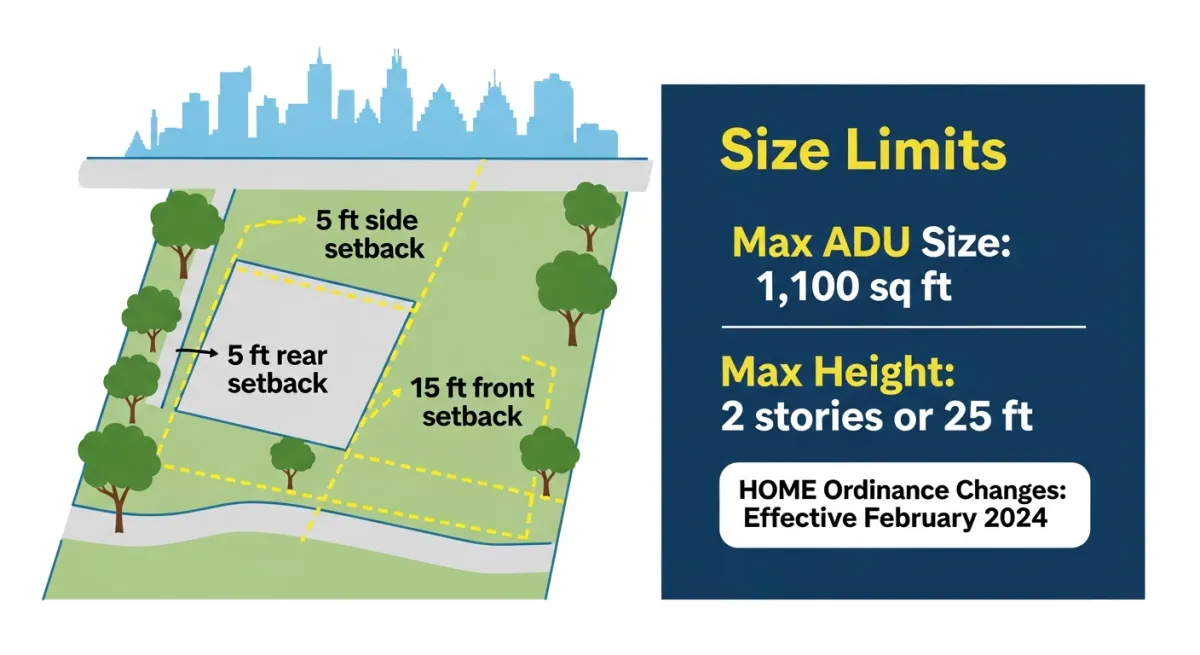
Rear and side setbacks dropped to five feet under HOME Phase 2, which passed in 2024. This trips people up constantly: the setback reductions are Phase 2, not Phase 1. The size calculation also shifted — from a hard 1,100-square-foot ceiling to either 1,100 square feet or 15 percent of lot area, whichever is larger. On bigger lots, that matters.
What homeowners most commonly get wrong: they still think they need to live on-site, still think the setback is 10 feet, still think they’re limited to one ADU. The practical result is that people either skip projects they’re now allowed to build, or spend weeks designing around constraints that no longer exist.
What Your Lot Can Actually Hold
The post-HOME baseline for ADUs on standard single-family zoning in Austin looks like this, pending verification of specific figures with DSD:
| Rule | What the Code Reportedly Now Says |
|---|---|
| Rear setback | 5 feet (HOME Phase 2; verify with DSD) |
| Side setback | 5 feet (HOME Phase 2; verify with DSD) |
| Max ADU size | 1,100 sq ft OR 15% of lot area, whichever is larger (verify LDC text) |
| Height allowance | Two stories (verify with DSD) |
| Units per lot | Up to 3 total (main house + 2 additional) |
| Owner-occupancy | Not required; legal challenge status — confirm with DSD |
On a standard 5,750-square-foot lot in North Loop or East Cesar Chavez, 15 percent of lot area works out to about 862 square feet — so the 1,100-square-foot floor controls. On a larger lot in parts of South Austin, 15 percent can push meaningfully above 1,100 square feet. Run the numbers on your specific address before you assume the ceiling.
The five-foot setback creates a real design opportunity on tight lots. Under the old 10-foot standard, some of these lots looked infeasible. A lot with 30 feet of rear yard depth now offers 25 usable feet from the setback line rather than 20 — enough for a one-bedroom footprint where it previously wasn’t.
The two-story allowance matters less for square footage than for lot coverage. Going vertical keeps your ground-level impervious cover lower while still building meaningful living space. But lot coverage limits still apply under watershed and overlay regulations, and on many Austin lots where the main house already covers significant ground, those constraints end up driving the design more than anything in HOME. These are the citywide defaults. Whether they apply to your specific address is a separate question.
When the Citywide Rules Don’t Apply
A significant share of Austin lots sit in overlays, watersheds, or historic districts. Those impose their own constraints, sometimes instead of the HOME baseline. This is where project plans fall apart after design work — sometimes expensive design work — has already begun.
Save Our Springs overlay. The SOS overlay covers large portions of 78704 (Travis Heights, Galindo, portions of Bouldin Creek) and 78745 (Manchaca Road corridor, Cherry Creek). Impervious cover limits are tighter than the citywide standard. On a lot with an existing house and driveway, you may already be near your SOS limit before you’ve poured a single ADU foundation. This kills more projects than any other overlay, and it catches people off-guard when they discover it mid-design. Check your watershed designation first, before you do anything else.
Historic districts. Hyde Park, Clarksville, and Wilshire Wood have Historic Design Standards. New construction — including ADUs — requires Historic Landmark Commission review. The setbacks and size limits of HOME may technically allow your ADU, but HLC review means a design compatibility evaluation on materials, scale, and massing. Budget additional months and additional architect time if your address falls inside a historic district boundary.
Floodplain. Properties along Shoal Creek and Waller Creek corridors sit in FEMA-mapped floodplain zones. They require elevation certificates, sometimes engineered fill, and in some cases a FEMA floodplain development permit before a city building permit can issue. Austin’s Flood Early Warning System portal and FEMA’s Flood Map Service Center are the right tools to check before design begins.
Heritage trees. In Zilker, Barton Hills, and older Central Austin neighborhoods, lot-dominating live oaks regularly determine where an ADU can and cannot be sited. An arborist report, critical root zone analysis, and Urban Forestry review may be required — and the constraints can make a project infeasible in its originally envisioned location. Anyone who has tried to site a structure around a mature Central Texas live oak knows the tree usually wins.
Mueller. Mueller operates under a Planned Unit Development with its own design standards and compatibility rules that differ from the HOME defaults. Mueller homeowners should contact the PUD administrator and read the PUD documents directly.
If your address falls into any of these situations, the citywide rules are background information, not your answer.
The Permit Reality in 2026
Austin’s Development Services Department processes ADU permits through the Austin Build + Connect portal at 6310 Wilhelmina Delco Dr.
After you submit plans, DSD’s first step is confirming the application package is complete — all required documents, the right plan sheets, applicable checklists. For a straightforward detached ADU submittal, expect two to four weeks for that intake review.
Once accepted, the application enters the review queue. Multiple departments review independently: building, zoning, floodplain (if applicable), tree review (if applicable), fire, Austin Energy. For a new detached ADU with no overlay complications, contractors currently report first review cycles of six to ten weeks. Each complication — heritage trees, SOS impervious cover calculations, historic design review — doesn’t just add weeks. It adds months.
Almost every project gets comments back. Missed dimensions. Notes on foundation type. Clarification on utility routing. A competent architect who knows the Austin ADU process can usually turn revisions in one to two weeks. Re-review follows. Once all approvals are confirmed, permit issuance is fast — a few business days.
Realistic total window for a new detached ADU on a straightforward lot: four to eight months from first submission to permit in hand, based on contractor-reported experience. For a garage conversion, contractors report as little as six to twelve weeks in clean cases, though the variance is wide depending on the garage’s condition and what’s being done to it.
DSD offers pre-application conferences — a paid intake meeting where staff will review your site plan and flag known conflicts before you invest in full construction documents. On a complicated lot, this is worth the money. Ask DSD for the current fee when scheduling.
What a Finished ADU Actually Costs in 2026
The $150 to $300 per square foot range you’ll find in most national consumer explainers doesn’t reflect what Austin contractors are quoting. The gap is significant, and closing it before you set your budget matters.
New detached site-built construction in Austin runs approximately $280 to $420 per square foot all-in — foundation, framing, MEP, finishes. At 600 square feet, that’s roughly $168,000 to $252,000 before soft costs. At 1,000 square feet, roughly $280,000 to $420,000. Confirm these figures through contractor interviews; they move.
Garage conversions typically run $80,000 to $150,000 depending on scope and what the garage looks like now. Prefabricated ADU units may cost less as a unit than site-built, but Austin site work adds substantially. Foundation, utility connections, delivery, permits — by the time you’re done, total all-in cost for a prefab in Austin often matches or exceeds site-built. That’s not something the prefab companies’ marketing materials emphasize.
Two reasons Austin costs more than national figures suggest. First, the city’s expansive clay soils require pier-and-beam or engineered slab foundations rather than simple poured slabs — this drives foundation costs significantly higher than in most other markets. Second, Austin’s construction labor market has stayed tight, keeping subcontractor rates elevated.
Soft costs deserve their own line items, because contractors routinely leave them out of bids. Architect and designer fees for a detached ADU typically run $8,000 to $25,000 (more for historic districts). Structural engineering runs $3,000 to $8,000. City permit fees typically land between $5,000 and $15,000 depending on project valuation — verify the current schedule with DSD. Tree review, floodplain, and historic designation fees vary by project and stack on top of that. If you’re weighing the ADU investment against other improvements, our coverage of home improvements and resale value in Central Texas can help frame the longer-term math.
The Utility Fee Trap Most ADU Budgets Miss
The single line item that most reliably blows ADU budgets — after foundation surprises — is utility hookup costs. These don’t appear in most contractor bids. They’re not part of the construction contract. They land on the homeowner directly, they’re non-negotiable, and they tend to arrive at the worst possible moment in the project.
Austin Energy charges for new meter service installation and, where necessary, distribution line extension. Costs depend on distance to the transformer and site conditions. Estimates range from roughly $2,500 to $15,000 or more. Request a service extension estimate directly from Austin Energy before you finalize any budget — they’ll provide one as part of the pre-construction process.
Austin Water charges tap fees for new water service connections and wastewater connection fees based on meter size. Water tap fees currently land around $4,000 to $12,000 depending on meter size, with wastewater fees in a similar range. Confirm current figures directly with Austin Water. Many owners share the existing home’s meter to avoid tap fees, but shared metering complicates billing and can create headaches if you ever want to sell or finance the ADU separately.
Combined, utility hookup costs routinely add $15,000 to $40,000 or more to an ADU project. Any contractor bid that doesn’t break out utility connection costs as a separate line item deserves a direct question: what exactly is and isn’t included.
Can You Airbnb Your ADU
Yes, no, and it depends — but the rules are actually specific enough to be useful.
Austin’s short-term rental ordinance divides STR licenses into two types. Type 1 licenses cover properties where the owner lives on-site. Type 2 licenses cover non-owner-occupied properties. Austin stopped issuing new Type 2 STR licenses in 2023, and that moratorium remains in effect. City Council has revisited STR rules repeatedly, so check current status before making any investment decision that depends on it.
Here’s where it gets complicated. The HOME ordinance eliminated owner-occupancy requirements for building or owning an ADU. It did not touch the STR licensing structure. Those are separate code sections, and HOME didn’t amend them. So: if you build an ADU and live in the main house, you may be able to apply for a Type 1 license and rent the ADU on Airbnb legally. If you don’t live on the property, you can’t get a new Type 2 license under current rules. The city has increased STR enforcement, so this isn’t a distinction to fudge.
For long-term rental — standard 12-month leases — no STR license is required. HOME eliminated owner-occupancy restrictions for long-term rentals, subject to the same ongoing legal challenge noted earlier.
Before You Call a Contractor
The homeowners who get through Austin’s ADU process without expensive surprises tend to do the same things before spending money on design.
Start with Austin’s GIS portal. Enter your address and pull zoning classification, watershed designation, historic district membership, and floodplain status. This is where you find out you’re in the SOS watershed, or inside a historic district boundary, or in a FEMA floodplain zone. It’s free, which is more than you can say for finding out at the architect’s desk.
Schedule a DSD pre-application conference before hiring an architect. Bring a basic site plan. DSD staff will flag known issues — heritage trees, overlay restrictions, utility easements — before you’ve committed to full construction documents. Most experienced Austin ADU architects attend these with clients as standard practice.
When you’re getting contractor bids, ask explicitly: Does this include the foundation? Does it include utility connection costs or just the building-side work? Have you permitted ADUs in this zip code? A contractor who has worked in 78704 knows the SOS overlay from experience. A contractor who primarily works in 78729 may not. Ask for references on completed Austin ADU projects and actually call them.
Construction loans, HELOCs, and cash-out refinances are the most common ADU financing tools locally. A few lenders have developed dedicated ADU loan products; local credit unions have been active in this space and are worth calling.
Build a full timeline from your architect and contractor before making any income or occupancy projections. The permit window alone runs four to eight months. Construction after permit issuance adds more time depending on scope. Rushing any phase creates problems in the next one — occasionally expensive ones.
Austin’s ADU rules in 2026 are more permissive than they were three years ago — smaller setbacks, more units per lot, and meaningful changes to owner-occupancy requirements. But permissive rules don’t override a bad watershed position, a heritage tree in the wrong spot, or utility hookup costs that weren’t in the budget. The homeowners who do well are the ones who sorted those questions out before they signed anything. For broader context on Austin development and housing policy, this article is part of our home & property coverage.
CityDesk Austin covers local development, business, and policy. Send tips or corrections to the newsroom.