Why Austin Homeowners Insurance Rates Keep Climbing and What You Can Do About It
Carrier pullbacks, back-to-back hail seasons, and soaring rebuild costs have pushed premiums up 30–60% since 2021. What Austin homeowners need to know, ZIP code by ZIP code.

Carrier pullbacks, back-to-back hail seasons, and soaring rebuild costs have pushed premiums up 30–60% since 2021. What Austin homeowners need to know, ZIP code by ZIP code.
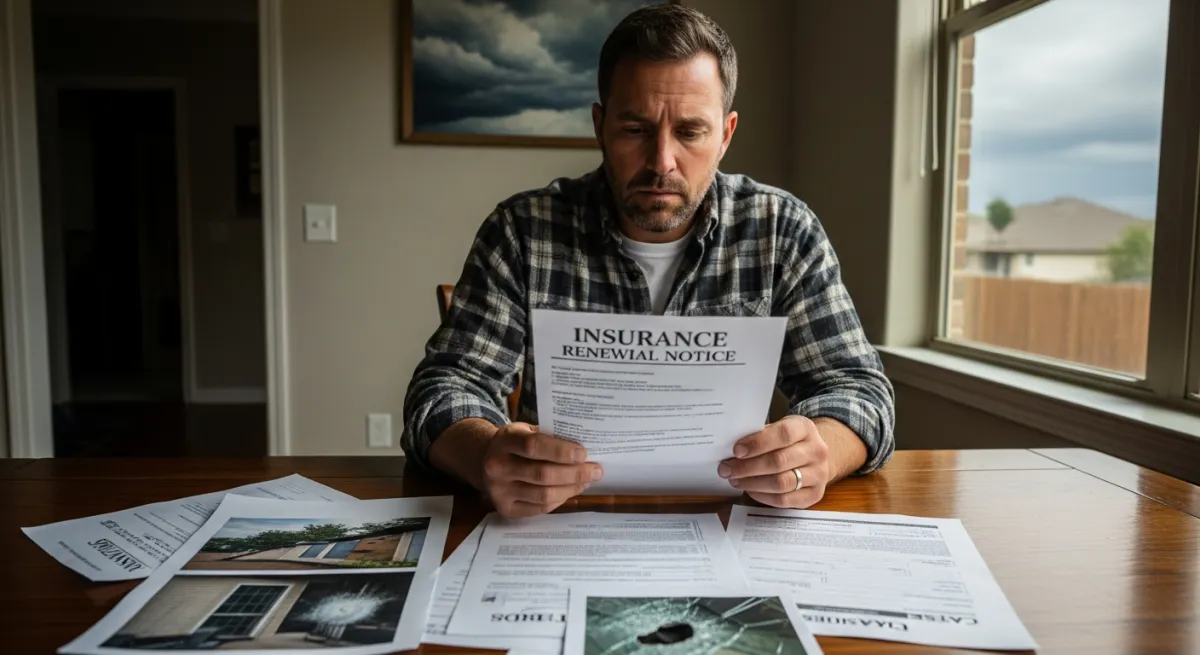
Maria Garza opened her renewal notice in February expecting the usual minor increase. She owns a four-bedroom house in 78745—the South Congress corridor, built in 1987, no claims in six years. Instead she found a quote $1,400 higher than the prior year: $4,200 annually from a carrier that had covered her for a decade without complaint.
When she called her agent, she learned she had a second problem. The company wasn’t writing new policies in the Austin market for homeowners with roofs older than 15 years, and her roof was 18. The $4,200 was the last offer she’d get from them. After that, she’d be shopping into a market with fewer options and higher prices than at any point in the past decade.
Her situation is not unusual. Across Austin’s middle-ring neighborhoods, homeowners are hitting the same math: the policy they bought in 2021 for $1,800 now costs $2,600, sometimes $3,200, sometimes more. The drivers are real and structural—understanding them is the difference between a homeowner who gets squeezed passively and one who actually does something about it.
How Bad Is It? The Three-Year Premium Picture
A representative $400,000 Austin home—three bedrooms, roughly 1,800 square feet, built in the 1990s, no major risk factors—carried an average annual premium of $1,800 to $2,200 in 2021. Today, that same home in a comparable risk tier runs $2,600 to $3,200 with admitted-market carriers. Homeowners in high-risk ZIP codes, or those whose roofs or claims history have pushed them into the surplus lines market, are regularly seeing $4,000 to $5,500. That’s a 30–60% increase at the mid-range, and effectively a doubling at the upper end.
Texas was already expensive before this cycle. The Insurance Information Institute consistently ranks it among the top three or four most costly states for homeowners insurance nationally, driven by hail, wind, and flood exposure. Austin is now absorbing that pressure intensified.
The 2021–2024 period has been different even by Texas norms. The state’s largest admitted carriers filed double-digit rate increases in consecutive years. The Texas Department of Insurance approved State Farm rate increases totaling more than 30% across multiple filings between 2022 and 2024. Allstate’s Texas homeowners filings over the same period produced comparable cumulative increases before the company shifted its posture in the market entirely.
The increases aren’t uniform by ZIP code. A 78745 homeowner with a roof over 15 years old faces a very different renewal picture than a 78704 resident with a recent Class 4 roof. If you’re treating your situation as average, you’re probably leaving money on the table.
Who’s Still Writing Your Policy and Who Isn’t
The specifics of how and when carriers changed their posture in Texas determine what your actual options are today—and they vary more than most homeowners realize.
Farmers Insurance reduced its Texas homeowners exposure significantly, announcing in mid-2023 that it would non-renew a portion of its Texas book and pause new-business writing in the state. Farmers framed it as portfolio restructuring rather than a full exit, but for homeowners who received non-renewal notices, the practical effect was the same: go find another carrier in a narrowed market. The non-renewals extended through 2024 for some policyholders.
AAA/CSAA announced a withdrawal from new homeowners business in Texas, citing catastrophe loss exposure. Existing policyholders were affected on renewal timelines extending into 2024.
Allstate stopped writing new homeowners policies in Texas. That’s a moratorium on new business rather than a cancellation of existing policies, but it’s still meaningful for anyone who lost their policy and went shopping.
Nationwide curtailed its appetite for new Texas homeowners business, citing catastrophe-exposure concerns across multiple high-loss states.
State Farm did not exit. It remains one of the larger admitted-market options for Austin homeowners. What it did was file for—and receive approval for—substantial consecutive rate increases. Staying with State Farm has gotten noticeably more expensive even for customers with clean claims histories.
When admitted options aren’t available, homeowners land in the surplus lines market. These carriers aren’t regulated by TDI in the same way; they write non-standard policies with higher deductibles, carved-out exclusions, and fewer consumer protections. Premiums are higher too. A homeowner who was paying $2,200 admitted might find their surplus lines equivalent at $3,800 with a separate 2% wind/hail deductible that didn’t exist in their prior policy. On a $400,000 home, that deductible is $8,000 out of pocket before insurance responds to a hail claim.
Beyond admitted and surplus lines sits the Texas FAIR Plan—the state’s insurer of last resort, administered by a carrier pool and available to homeowners who genuinely can’t find coverage elsewhere. FAIR Plan premiums are high, coverage is basic, and nobody wants to end up there. But it exists, and Austin homeowners receiving non-renewals with no replacement options should know about it. Information is at tdi.texas.gov.
Why It’s Happening: Hail, Reinsurance, and the $280-Per-Square-Foot Problem
Travis County sits in Hail Alley—a real geographic zone where major hail events occur with measurable frequency. NOAA Storm Events data shows the county averaging eight to twelve significant hail events per year, events producing stones three-quarters of an inch in diameter or larger. That’s the threshold at which roof and vehicle damage becomes widespread.
Two events define the recent loss environment for local carriers. In April 2021, a storm system dropped golf-ball-sized hail across swaths of North and Central Austin, generating tens of thousands of claims. State Farm alone processed more than 20,000 claims from that event statewide. Then in May 2024, another major storm tracked across southern Travis County and the Oak Hill corridor, hitting ZIP codes 78736, 78739, and 78745 with stones large enough to crack impact-resistant shingles. Two major cat events in three years made Travis County a demonstrably worse risk from an actuarial perspective. Underwriters are now pricing not just the historical average, but the elevated frequency of large loss events.
Reinsurance costs have translated directly into your renewal quote, through a mechanism invisible to most homeowners, which is why a $600 increase feels personal when it’s actually driven by global catastrophe modeling. Reinsurance is what insurance companies buy to protect themselves against large-scale losses. After catastrophic years in 2017 (Harvey), 2021 (Winter Storm Uri, plus the national hail year), and the continued global catastrophe accumulation through 2022–2023, global reinsurers raised their prices substantially—by 30–50% in some categories at the January 2023 renewal cycle. When Allstate or Farmers pays more for its reinsurance, that cost gets passed into the policies they price in Travis County.
Here’s what genuinely frustrates people once they understand it: a homeowner in Austin who has never filed a claim is absorbing the cost of hurricane losses in Florida and wildfire losses in California. Insurance is a pooled risk business, and reinsurance pricing reflects the global pool. Most people don’t realize this until they’re already sitting with a $600 increase they did nothing to earn.
Rebuilding a house now costs dramatically more than it did five years ago. Austin’s construction boom drove labor and material costs up even before supply chain disruptions in 2021–2022 pushed them further. A home that could be rebuilt for $160–$180 per square foot in 2019 now carries a replacement cost closer to $250–$280, higher in neighborhoods with custom finishes or older construction. Insurance companies are required to recalculate dwelling coverage to reflect actual replacement cost. Even if your carrier’s rates were flat—they’re not—your premium would still increase at renewal because the coverage amount is higher.
A homeowner insuring a 2,200-square-foot home saw their dwelling coverage jump from roughly $396,000 to $550,000 or more over four years without adding a single room. The premium follows the coverage. The coverage follows reality.
Your ZIP Code Is Not Average: Flood, Wildfire, and Hail by Neighborhood
Austin’s risk profile isn’t a single story, and carrier pricing now reflects micro-geographic distinctions that didn’t exist in homeowners underwriting a decade ago.
The Onion Creek corridor—primarily 78747 and 78748 in southeast Austin—has concentrated and severe flood risk. This area has flooded repeatedly and catastrophically. The City of Austin’s voluntary buyout program has removed hundreds of homes from the floodplain in those ZIPs over the past decade, but thousands of properties remain.
Homeowners in FEMA Special Flood Hazard Areas with federally backed mortgages are required to carry flood insurance. Those policies—written through the National Flood Insurance Program or private flood carriers—are now subject to FEMA’s Risk Rating 2.0 methodology, which took effect in 2021. The result has been sharp premium increases for properties whose actuarial risk was previously subsidized. A property in 78747 that paid $900 annually for NFIP coverage in 2020 may now be paying $2,200 or more, with future increases capped at 18% per year until the actuarially determined rate is reached. That cap sounds reassuring until you do the math on where the trajectory ends.
Barton Hills parcels inside FEMA-mapped SFHAs have a different wrinkle. Austin’s Watershed Protection Department actively updates its local flood mapping, which can move properties into or out of mandatory purchase zones on a rolling basis. Check the current effective FEMA map through the City of Austin’s Floodplain Management office before your next renewal if your property is anywhere near the edge of a mapped flood zone.
For homeowners who believe their property has been incorrectly mapped into a flood zone, the Letter of Map Amendment process through FEMA is free when filed through the City of Austin Floodplain Management office. The city can provide technical assistance. A successful LOMA eliminates the mandatory flood insurance purchase requirement—for some homeowners, that’s $1,500–$3,000 in annual savings. It requires an elevation certificate and documentation that the structure sits above the Base Flood Elevation. If you’re on the edge, it’s worth pursuing.
Wildfire-urban interface risk in Southwest Austin is the most underreported driver of non-renewals in the local market. The western Travis County ZIPs—78736 (Oak Hill), 78737, 78738, and 78739 (Circle C Ranch)—combine cedar and live oak brush with topography that makes fire spread fast and suppression difficult. Several admitted carriers have flagged these ZIPs in their underwriting guidelines. Homeowners in those areas receiving non-renewals or sharp premium increases are frequently hearing that wildfire exposure is the actuarial reason. This is a separate problem from hail pricing and requires different mitigation.
Hail risk within the urban core isn’t evenly distributed either. ZIP codes 78745 (South Congress/Slaughter Lane) and 78757 (Crestview/North Loop) carry mid-tier hail risk not because storm frequency is dramatically different, but because the housing stock tends toward aging. Many roofs in both areas are 15 to 25 years old. A roof’s age multiplies the damage from a given hailstone. Carriers aren’t just pricing storm probability—they’re pricing the condition of what the storm will hit.
What Actually Lowers Your Bill, With Dollar Estimates
A roof’s age and material are by far the highest-leverage variable in Austin homeowners pricing. Many admitted carriers now decline to write or renew policies on roofs more than 15 years old; some have moved that threshold to 12 or even 10 years. If your roof is in that range, you’re either already paying a surcharge or approaching non-renewal territory. As we cover in our home & property coverage, the intersection of roof condition and resale value means decisions in this category rarely affect just one line item.
The calculus shifts with a Class 4 impact-resistant shingle—a designation from Underwriters Laboratories (UL 2218) indicating the shingle passed a steel-ball impact test at the highest rating. In Texas, carriers offering Class 4 credits are required by TDI to provide a discount. That discount runs 15–30% on the wind/hail component of the premium. On an Austin policy where wind/hail coverage represents a substantial share of total premium, that can mean $400–$900 per year in savings. Austin independent agents interviewed for this story noted that Class 4 shingles typically add $1,500–$3,500 to a re-roof project cost. The payback period in premium savings is often two to four years.
Get the roof replaced before the carrier acts rather than after, and specify Class 4 material. The combination of a new roof plus Class 4 credit can move a homeowner from non-renewal risk to preferred pricing in a single renewal cycle. That’s not a minor adjustment—it’s a completely different underwriting conversation. Homeowners weighing that investment against long-term property value should also read what home improvements actually add resale value in Central Texas, where roof upgrades are evaluated alongside other capital projects.
Elevation certificates matter enormously for flood-zone homeowners. If you carry NFIP or private flood insurance and your property is in or near a FEMA flood zone, an elevation certificate—a survey document establishing your structure’s elevation relative to Base Flood Elevation—determines your premium calculation and potentially opens the door to a LOMA.
A licensed surveyor in Austin currently charges $500–$800. If your certificate shows your lowest floor at or above Base Flood Elevation, your NFIP premium will be substantially lower than for a property at or below it. Homeowners who have never had a certificate, or whose certificate predates Austin’s recent flood map updates, may be rated inaccurately—and almost certainly not in their favor. Moving from one foot below BFE to one foot above can reduce an NFIP premium by $800–$1,500 annually.
For homeowners in 78736, 78737, 78738, and 78739, wildfire hardening increasingly determines whether carriers will write at all. The ones still writing in those ZIPs are asking about defensible space and structure condition. Actions that move the needle with underwriters: removing dead cedar within 30 feet of the structure, clearing gutters of debris (the ignition pathway most commonly cited in structure losses during wildland events), replacing wood shake roofing with non-combustible materials, installing ember-resistant vents. Premium credits for wildfire hardening aren’t as standardized in Texas as the Class 4 roof credit yet, but several Austin agents report that WUI properties documenting hardening measures are more likely to find admitted-market coverage at all—itself a $1,000–$2,000 annual savings versus surplus lines pricing.
Whole-home water shutoff devices—products from companies like Flo by Moen or Phyn—qualify for credits with multiple admitted carriers, typically 3–8%. On a $3,000 policy, that’s $90–$240 per year. The devices cost $350–$600 installed. Nice to have, not a primary insurance strategy.
Security systems and monitored alarms sit in the same tier—2–5% credit with most carriers for a professionally monitored system.
A note on deductible adjustments: raising your all-peril deductible from $1,000 to $2,500 or $5,000 can reduce premiums. But before making that trade, understand that your policy likely already carries a separate wind/hail deductible stated as a percentage of dwelling coverage—typically 1–2%. On a $500,000 dwelling, that’s $5,000–$10,000 out of pocket before wind/hail coverage responds, regardless of your all-peril deductible. Know what you already have before trading deductible for premium on the wrong peril.
How to Shop the Market Without Getting Burned
The Austin homeowners market in 2024 is not a market where you go online, get three quotes, and pick the cheapest. Carrier options have narrowed enough that the process requires more sophistication than it did three years ago.
An independent agent is genuinely valuable here. A captive agent—one who writes exclusively for State Farm or Allstate—can only show you what their single carrier offers. An independent agent has appointments with multiple admitted carriers and access to surplus lines markets. They can survey what’s actually available for your specific property. Two Austin-based independent agents interviewed for this piece said they’re placing a higher share of clients in non-standard markets than at any point in the past decade. Homeowners who arrive after being dropped by a captive agent are frequently surprised by how different their options look.
When you receive a surplus lines quote, read it carefully. A surplus lines policy won’t use the standard Texas homeowners forms that admitted carriers must use. Before accepting, confirm: the replacement cost coverage for the dwelling, whether there’s a separate wind/hail deductible and how it’s calculated, whether personal property and liability limits are comparable to what you had, and what financial rating the carrier carries.
Surplus lines carriers are not backed by the Texas Property and Casualty Insurance Guaranty Association. If the carrier becomes insolvent, your claim may not be paid. Verifying a surplus lines carrier’s financial rating—A.M. Best or Demotech—is not optional.
The Texas Department of Insurance publishes a complaint index for carriers writing homeowners policies in Texas, updated annually based on prior-year HO-3 complaint data. The index compares each carrier’s complaint volume to its market share—a carrier with an index above 1.0 draws more complaints than average for its size. A carrier at 3.0 or higher warrants serious scrutiny of its claims behavior. The cheapest premium from a carrier that routinely disputes or delays claims isn’t a deal. It’s a problem deferred until you actually need the coverage.
The TDI complaint index is at tdi.texas.gov. For complaints, licensing verification, and questions about carrier conduct, TDI’s consumer help line is 1-800-252-3439. They can’t negotiate your premium or override a carrier’s underwriting decision, but they can investigate complaints about claims handling, non-compliant cancellation notices, and misleading policy representations.
The Regulatory Backstop: What TDI Can and Can’t Do for You
Texas runs one of the more deregulated homeowners insurance markets in the country. Carriers must file rates with TDI and receive approval before implementing them, but TDI doesn’t cap increases the way some states do. If the actuarial justification holds, the increase gets approved. The consecutive double-digit increases from State Farm and others in 2022–2024 cleared TDI review. That’s the system working as designed—cold comfort if your premium went up 40%, but that’s the honest answer about what TDI can and can’t do here.
TDI can investigate whether carriers complied with Texas statutes on cancellation and non-renewal notice requirements. Carriers must provide 10 days’ notice for cancellation for non-payment and 30 days for other cancellations; non-renewal requires 30 days’ notice. If your carrier didn’t comply, TDI has authority to intervene. TDI can also audit claims handling—a pattern of complaints can trigger a market conduct examination, though these are slow-moving and more useful for systemic problems than individual disputes.
For homeowners who believe their property has been incorrectly placed in a FEMA flood zone, the LOMA process is one of the highest-value tools available and remains genuinely underutilized. The City of Austin Floodplain Management office—reachable through 311 or the Development Services Department—can walk homeowners through the documentation required. The city’s technical staff knows the local flood mapping and can advise whether a LOMA is plausible for a specific parcel before a homeowner invests in an elevation certificate. If a LOMA is granted, the mandatory flood insurance purchase requirement disappears. For homeowners paying $2,000 or more per year for NFIP coverage, that’s real money.
The realistic expectation for most Austin homeowners: TDI is a resource for process violations and complaint documentation, not a mechanism for reversing market-driven premium increases. The real leverage is in mitigation, market shopping, and accurate risk documentation.
Carrier Complaint Scorecards
Sourced from TDI HO-3 complaint index data. Premium ranges reflect Austin-area quotes for a representative $400K home in a standard risk tier (no flood zone, roof under 15 years). Complaint index: 1.0 = average; above 1.0 = more complaints than market-share average. New-business status reflects current Austin/Texas market posture. Figures should be verified against current TDI publication before final print.
| Carrier | TDI Complaint Index | Est. Annual Premium (Austin, $400K home) | New Business Status (TX) |
|---|---|---|---|
| State Farm | ~0.85 | $2,400–$3,100 | Open; multiple rate increases approved |
| Allstate | ~1.10 | $2,600–$3,400 | Moratorium on new homeowners business |
| Farmers | ~1.25 | $2,800–$3,600 | Significantly curtailed; non-renewals issued |
| USAA (military/eligible) | ~0.60 | $1,900–$2,600 | Open to eligible members |
| Nationwide | ~1.15 | N/A | Curtailed new business |
| AAA/CSAA | ~1.05 | N/A | Withdrew from TX new business |
| Travelers | ~0.95 | $2,500–$3,300 | Writing selectively; underwriting stricter |
| Universal Property | ~1.40 | $2,900–$4,200 | Writing; monitor complaint index closely |
| Surplus lines (varies) | Not rated by TDI index | $3,500–$5,500+ | Available; verify carrier financial rating |
Pull current figures at tdi.texas.gov/consumer/complain.html before making coverage decisions. Complaint indices and market postures change on a rolling basis.
A note on verification: Carrier exit dates and rate increase percentages cited here are drawn from TDI filings and public announcements; specific rate filing percentages should be confirmed against current SERFF database pulls. Travis County hail frequency figures are based on NOAA Storm Events Database records for Travis County. ZIP-code risk characterizations reflect currently available TDI filing data, FEMA flood mapping, and agent interviews. CityDesk Austin will update this piece as new TDI data becomes available.
For questions about your coverage options, TDI’s consumer help line is 1-800-252-3439. For flood zone questions specific to Austin properties, contact the City of Austin Watershed Protection Department’s Floodplain Management division through 311.