How to Prepare Your Austin HVAC System for Summer Heat
Austin summers don't ease up gradually. They arrive fast, stay long, and punish any mechanical weakness in your home with compounding urgency. By the time you notice your house struggling to hold t…

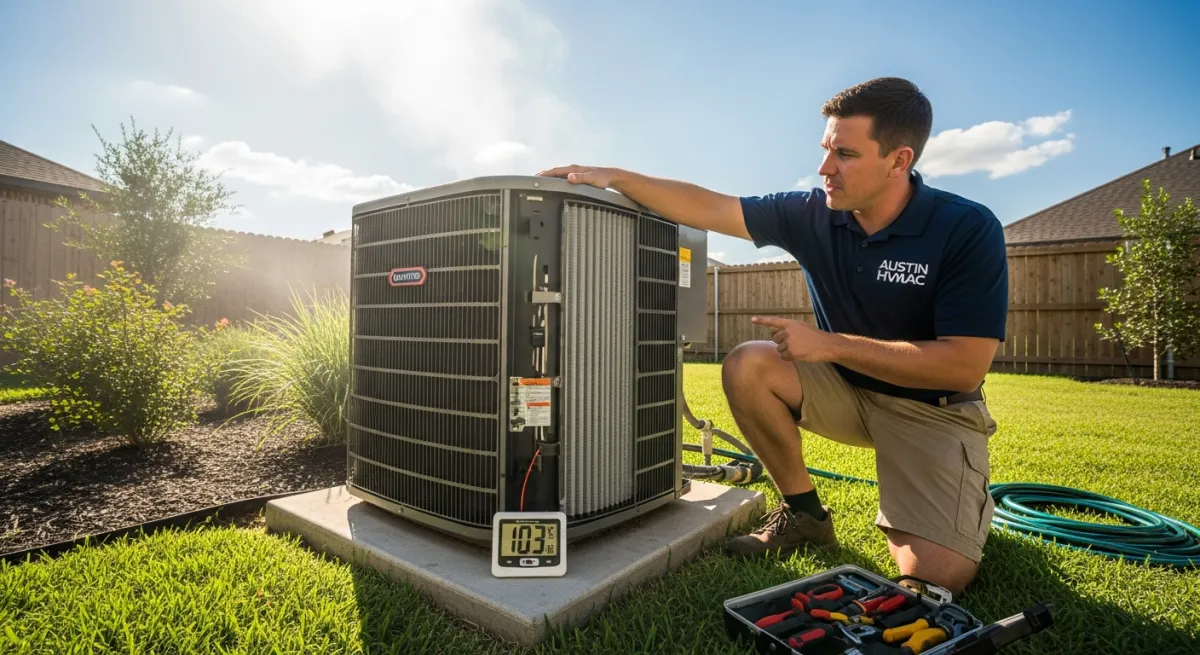
Austin summers don’t ease up gradually. They arrive fast, stay long, and punish any mechanical weakness in your home with compounding urgency. By the time you notice your house struggling to hold temperature on a 104°F afternoon in July, every HVAC technician in Travis County is already booked out days. Act in January or February instead, when your options are wide open and your contractor can actually give the work the attention it deserves.
This is a specific guide for Central Texas conditions, not a generic home-maintenance checklist. The R-values, rebate amounts, booking windows, and failure patterns described here reflect Austin’s climate, housing stock, and utility programs as of early 2025.
Why Austin Is Harder on Home Cooling Systems Than Almost Anywhere Else
The honest number is roughly 74 days above 100°F annually in a bad Central Texas summer, though recent years have pushed past that. What makes Austin particularly brutal for mechanical systems isn’t just the peak temperature — it’s that there’s no relief. During the 2023 heat dome, Austin recorded extended stretches where overnight lows stayed above 80°F.
That matters mechanically. An air conditioning system that runs from 8 a.m. to midnight gets a few overnight hours to idle. A system running 22 or 23 hours a day because the ambient temperature never drops doesn’t get that window. Capacitors overheat. Refrigerant pressure spikes. Motors run at maximum load without rest.
The 2023 event was a preview worth taking seriously — and most Austin homeowners still haven’t internalized what it meant. HVAC companies across the metro reported emergency call backlogs stretching three to five days during the worst weeks. Homeowners with a failed system waited in triple-digit heat. Some of that backlog was end-of-life equipment. Much of it was systems that hadn’t been serviced in years and failed under a load they’d never seen before.
Austin is also geographically awkward for cooling. The urban heat island effect downtown, the limestone and caliche soils that radiate heat back upward, and the sprawl into hotter suburban corridors in Kyle, Pflugerville, and Manor all combine to create a heat load that’s higher than what national insulation and equipment standards assume. A home in South Austin faces meaningfully different cooling demands than an equivalent home in more moderate climates — a fact that becomes obvious the first time you move here from somewhere with a real autumn.
When Austin HVAC Contractors Fill Up
January and February are your best months to schedule a pre-summer inspection. March is the last comfortable window. By April, lead times at major Austin shops typically run one to three weeks for non-emergency work. Memorial Day onward is emergency-only territory.
Companies like Strand Brothers Service Experts, ABC Home & Commercial Services, and Houk Air Conditioning all run substantial residential operations in the Austin metro. Call them directly rather than relying on online booking systems, which often don’t show real availability. A phone conversation with a dispatcher will tell you more in two minutes than a web portal will.
If you wait until April: you’ll either get a three-week wait or pay emergency rates to jump the line. Neither is where you want to be. A thorough inspection only happens when the technician isn’t squeezed between three emergency calls on a 100°F afternoon in June. Diagnostics, refrigerant charge checks, ductwork connections, electrical component testing — none of that gets done properly when someone’s got a failed unit across town waiting on the same truck.
Ask for a “preventive maintenance visit” rather than a “standard service call.” Most Austin contractors price these between $89 and $150. If your system is more than 10 years old, ask specifically for a full system inspection — that usually includes a more thorough ductwork assessment, refrigerant measurement, coil cleaning, and a written equipment condition report. It costs more, and it’s worth it.
What a Pre-Summer Tune-Up Actually Covers
A standard tune-up includes cleaning the evaporator and condenser coils, checking refrigerant charge, testing electrical connections, lubricating moving parts, clearing the condensate drain, and cycling the system. That’s solid work for $89–$150 on a system that costs $5,500–$16,000 to replace.
What it doesn’t include: ductwork inspection beyond what’s visible at the air handler, a load calculation to confirm proper system sizing, or anything involving attic insulation. Those are separate conversations you have to initiate explicitly. Your contractor won’t bring them up unless you ask.
The age question matters more than most homeowners recognize. Systems installed before 2010 are now 15-plus years old. If yours is in that cohort, the tune-up conversation should include a frank discussion of replacement timing. An aging system typically costs more in emergency repairs over a few years than a modern unit would in monthly energy bills. The math isn’t close — and a good technician will tell you that plainly. If yours won’t give you a straight answer, that’s useful information too. For a broader look at how cooling upgrades and other projects perform at resale, home improvements that add resale value in Central Texas are worth understanding before you commit to a full system replacement.
One administrative note that catches people off guard: any system replacement requires a City of Austin mechanical permit, pulled by a licensed contractor. If a company offers to skip the permit to save time or money, walk away. Unpermitted work creates liability at resale and may void your equipment warranty.
The Six Things That Fail First in an Austin Heat Wave
Austin contractors see a consistent failure pattern when temperatures climb above 100°F and stay there. These aren’t random — they’re predictable outcomes of sustained thermal stress, which is most of what makes them preventable.
Capacitors are the single most common part failure. The capacitor provides the electrical boost that starts the compressor and fan motors. Under sustained heat, capacitors degrade faster than their rated lifespan, and a weak one is often the difference between a system that struggles and one that stops entirely. A good technician will test capacitor performance during a tune-up and flag one that’s reading below spec. Replacement runs $150–$300. Ignoring a weak capacitor until July costs more in every sense.
Refrigerant leaks accelerated by coil corrosion are the second major failure mode. Austin’s hard water contributes to coil corrosion in some areas. The system loses refrigerant charge gradually until it can’t maintain setpoint. A leak seal might run a few hundred dollars; coil replacement can hit $1,500–$3,500 or more depending on accessibility.
Flex ductwork failures in unconditioned attics deserve extended attention (more below), but the immediate point is temperature. Attic spaces in Austin homes regularly reach 140–160°F in summer. Flex duct that’s 25–30 years old can separate at connections, develop tears in the outer jacket, or collapse internally. When ductwork fails, your system runs continuously and barely moves conditioned air — which is exactly as maddening as it sounds.
Condenser fan motors on older units fail more often in West Austin neighborhoods, where west-facing outdoor condensers absorb afternoon sun load on top of ambient heat. These motors weren’t designed for the temperature extremes they face in a sustained Austin heat event.
Clogged condensate drain lines are a nuisance rather than a catastrophe — until the float switch shuts the system down entirely and water backs up into your ceiling. It’s a five-minute fix at a tune-up and a costly emergency call when you notice water stains in July.
Electrical contactor failure becomes more common during grid stress events, when voltage fluctuations spike. The contactor is the relay that connects line voltage to the compressor. Technicians can test and replace contactors during a tune-up. It’s also one of the checks that gets skipped on rushed service calls, which is something to watch for.
The Ductwork Problem Most Austin Homeowners Don’t Know They Have
Ductwork is the most underappreciated efficiency variable in a Central Texas home. Austin’s 1980s and 1990s housing stock has a specific problem that’s now 30 to 40 years old: original flex duct deteriorating in unconditioned attics.
Windsor Park, Crestview, Cherrywood, much of East Austin, and older sections of South Austin are exactly where this concentrates. The flex duct installed in those decades degrades in ways that aren’t visible from inside the house. The inner liner becomes brittle. The insulating wrap loses effectiveness. Connections at registers and the air handler loosen over years of thermal expansion and contraction. The result is a system pushing conditioned air into the attic rather than into living spaces.
The typical sign isn’t a dramatic failure. It’s a house that takes longer to cool than it used to, rooms that never quite reach the thermostat setpoint, and a summer electricity bill that runs higher than a comparable neighbor’s. Austin Energy’s average residential summer bill runs around $180–$250 for a typical 1,800–2,000 square foot home with a reasonably efficient system. Homes with significant duct leakage pay substantially more for the same square footage. If yours is consistently higher, that’s where to look first.
Duct sealing — applying mastic sealant or metal tape to leaking connections without replacing the runs themselves — costs roughly $1,500–$4,000 for a typical Austin home depending on scope. Full duct replacement, appropriate when the liner has degraded throughout, runs toward the higher end or beyond. These aren’t small numbers. But they’re smaller than four or five more summers of cooling an attic.
New construction in Kyle and Pflugerville faces a different but related problem: long duct runs serving large floor plans, sometimes with insufficient insulation on the duct itself. If you’ve moved into a newer home out there and noticed the master bedroom runs warm regardless of thermostat setting, duct run length and design is the first place to look.
Ask your contractor directly about duct condition during any pre-season inspection. Don’t wait for them to bring it up. They often won’t.
Attic Insulation: What Austin Energy Actually Recommends
Austin Energy recommends a minimum of R-38 for attic floor insulation, with R-49 to R-60 as the preferred standard for Austin’s heat load. Most pre-2000 homes don’t meet R-49. Many don’t meet R-38. Homes from the 1970s and 1980s were typically installed with R-19 to R-30, and insulation loses effectiveness over decades as it settles, compresses, or gets disturbed by attic work.
The problem concentrates in specific neighborhoods: Zilker, Bouldin Creek, Travis Heights, and Clarksville; most of inner East Austin built during the postwar boom; the 1980s suburban buildout in North Lamar, Rundberg, and older sections of Pflugerville and Cedar Park. ZIP codes 78702, 78703, 78704, 78751, and 78752 carry the highest concentration of homes below recommended levels. If you’re also tracking what your improvements mean for long-term value, our home and property coverage addresses the broader financial picture for Austin homeowners.
Blowing in additional loose-fill insulation to bring a 1,500 square foot attic floor from R-22 to R-49 typically costs $1,200–$2,500, depending on current depth and attic access. That’s real money, but it’s a fraction of what you’ll spend cooling a poorly insulated house through four or five more Austin summers.
Before calling anyone, measure your existing insulation depth at the attic access hatch. Four to six inches of settled insulation means you’re likely well below the minimum recommendation. This takes 90 seconds and a tape measure.
Austin Energy Rebates: What’s Available and What People Get Wrong
Austin Energy’s rebate program makes pre-summer upgrades cheaper, but it has requirements that homeowners miss regularly — and there are no after-the-fact exceptions.
For HVAC replacement, equipment must meet a minimum efficiency threshold of 15 SEER2. Heat pumps generally qualify for higher rebate amounts than standard central A/C. Attic insulation upgrades that bring a home to at least R-38 qualify separately, with more money available for reaching R-49 or above. The structure rewards going to the higher level, not just clearing the minimum. Verify all current amounts at austinenergy.com/go/rebates before contracting — program funding adjusts periodically and what was true six months ago may not be true now.
Home Performance with ENERGY STAR lets homeowners doing both an HVAC upgrade and insulation work access a bundled incentive, typically higher than the two separate rebates combined. It requires a participating contractor to do a whole-home energy assessment first. That’s an extra step, but the assessment itself is genuinely useful — in my experience covering these programs, homeowners often discover efficiency losses they weren’t tracking.
Income-qualified rebates exist for households at or below 200% of the federal poverty level. The amounts are significantly higher and can change the economics of an upgrade entirely. Worth checking before assuming you don’t qualify.
Here’s the piece that costs Austin homeowners real money every year: to receive an Austin Energy rebate, your contractor must be an enrolled Austin Energy Trade Ally. Not every licensed, competent, well-reviewed HVAC company in Austin is enrolled. A contractor can be all of those things and still not qualify you for a rebate. Before signing any contract for rebate-eligible work, ask directly: “Are you an Austin Energy Trade Ally?” Then verify it yourself at austinenergy.com. Using a non-enrolled contractor after the work is done is not fixable. The rebate is gone.
Stacking Austin Energy Rebates with the Federal 25C Tax Credit
The federal Inflation Reduction Act expanded the 25C energy efficiency tax credit, which stacks directly on top of Austin Energy rebates.
The 25C credit covers 30% of qualifying equipment costs, with caps by equipment type. For a qualifying central air conditioning system, the cap is $600. For a qualifying heat pump — which Austin Energy also incentivizes separately — the cap rises to $2,000. These are tax credits, not deductions. They reduce your federal tax liability dollar-for-dollar. That distinction matters when you’re calculating net cost.
On most full heat pump replacements in the Austin market, the 30% calculation hits the $2,000 federal cap. That $2,000 stacks on top of whatever Austin Energy rebate applies. For standard central A/C, the federal credit caps at $600 but still stacks. For attic insulation, 25C covers 30% of material costs up to $1,200, which stacks with the Austin Energy insulation rebate.
Confirm current eligibility requirements with a tax professional or at energystar.gov. Also confirm your contractor is providing the Manufacturer’s Certification Statement — the document that confirms qualifying efficiency rating. You’ll need it when you file. If your contractor seems uncertain what that document is, take note.
Pre-Summer Checklist for Austin Homeowners
Now, in January or February: Call and schedule a preventive maintenance visit. Ask specifically that ductwork condition be included in the assessment. Confirm the technician will check capacitors, refrigerant charge, and the condensate drain.
Before the contractor arrives: Measure your attic insulation depth at the access hatch and write it down. Pull your July, August, and September electricity bills from last year and note your kWh usage — Austin Energy’s online portal has your usage history if you’ve lost the paper bills. If you’ve never looked at your actual kWh numbers, prepare to be surprised.
During the visit: Ask explicitly about duct condition and age. Ask for a written estimate if any components test weak. Ask whether the system is approaching end of life and expect a real answer, not a sales pitch.
Before signing any rebate-eligible contract: Verify the contractor is an Austin Energy Trade Ally at austinenergy.com. Don’t take their word for it. Do it yourself.
For replacement work: Get written confirmation the contractor will pull a City of Austin mechanical permit. This isn’t a technicality — it protects you at resale and maintains warranty coverage.
If you’re a landlord: Austin’s City Code requires functional heating and cooling in rental units. Under Chapter 92 of the Texas Property Code, a tenant has the right to request repairs, and a landlord who fails to maintain A/C in a habitability-affecting situation faces real liability. Pre-summer servicing is a legal obligation. Worth being clear-eyed about that before July.
After summer: Compare your July, August, and September 2025 kWh usage to 2024. If you added insulation and had a tune-up, usage should drop. If it doesn’t, either ductwork wasn’t addressed, or the system is struggling despite servicing and should be replaced before 2026.
January and February are the right months to act. The cost of acting is a fraction of a failed system in July. Austin Energy’s rebate program makes the bigger upgrades substantially cheaper — as long as you use a Trade Ally contractor. The heat is coming. It always does, and it isn’t getting milder. The only variable is whether your home is ready for it.