How Much Does Foundation Repair Cost in Austin and Does Your House Really Need It
From Blackland Prairie geology to per-pier pricing, a ground-level guide for Austin homeowners

From Blackland Prairie geology to per-pier pricing, a ground-level guide for Austin homeowners
The calls started in the summer of 2022. They didn’t let up for nearly two years. Central Texas was grinding through one of its most severe droughts on record across Travis, Hays, and Williamson counties, and homeowners were noticing things they’d never noticed before. Doors that suddenly wouldn’t close. Diagonal cracks running up brick corners. Gaps opening at the base of interior walls.
That surge wasn’t panic or contractor marketing. It was geology doing what Austin geology does: the same expansive clay soil that makes the eastern half of this metro one of the most foundation-hostile environments in North America had spent eighteen months contracting, and houses were moving with it.
This guide is for the Austin homeowner who just noticed a crack or got a door that won’t latch. You’re trying to figure out if you have a $500 problem or a $25,000 problem — and the uncertainty is the hard part. We looked at local permit requirements, engineering standards, and what independent structural engineers charge to assess a job, because the national-average figures you’ll find on home improvement aggregators are basically useless when you’re budgeting a repair in Travis County. The Austin market is its own thing.
Why Austin Houses Move
You can draw a rough line along MoPac/Loop 1 where Austin’s foundation geology fundamentally changes.
West of that line, you’re on limestone. Westlake Hills, Bee Cave, the RM 2222 corridor, most of the Hill Country suburbs — they sit on the Edwards Plateau, a limestone formation that stays close to the surface and remains stable through weather shifts. It has its own engineering issues. Shallow bedrock means piers don’t always have good depth to reach load-bearing strata, and karst features create voids. But limestone doesn’t shrink and swell. West Austin homeowners have their own headaches; this just isn’t one of them.
East of MoPac is where the trouble lives. East Austin, Hyde Park, Mueller, St. John, Pflugerville’s older neighborhoods, Kyle, Buda, the Blackland Prairie corridor running up through Georgetown — these sit on montmorillonite clay. This mineral gives the Blackland Prairie its characteristically dark, sticky soil, and it works like a sponge. It absorbs water and expands, then loses water and contracts. The USDA Web Soil Survey and the UT Bureau of Economic Geology document Blackland Prairie soils as having among the highest shrink-swell potential of any soils in Texas. That’s not a ranking you want.
What actually causes damage isn’t steady drought or steady wet — it’s the cycling. Austin’s climate delivers prolonged dry spells, like the 2011 drought and the 2022–23 drought, punctuated by intense rain events that sometimes drop several inches in a few hours. The soil contracts unevenly during dry stretches because moisture loss happens faster at the perimeter of a slab than beneath it. Engineers call this “differential settlement.” The edges drop while the center holds, or vice versa, depending on drainage patterns and vegetation. The visible gap that opens when clay pulls away from the slab edge is sometimes called a “drought gap.” The professional advice to run a soaker hose at the foundation perimeter during dry spells responds to exactly this mechanism — it’s not folklore, it’s geotechnical engineering.
There’s a specific challenge at the Balcones Escarpment worth knowing about. The fault zone runs roughly along Lamar and US-183, and a single structure can span the transition from clay to limestone. A house with one corner on bedrock and the other three on clay is essentially anchored on one side and floating on the other. The Escarpment corridor produces some of the most complex repair jobs in the market. If your house sits anywhere near that transition zone, an independent engineer — not just a contractor — matters more than usual.
What Foundation Repair Actually Costs in Austin
Here’s the number most homeowners want first: a typical repair for a mid-size Austin home — say, a 1,600-to-2,200-square-foot slab on a conventional residential lot in East Austin or North Austin — runs between $8,000 and $20,000. Full slab replacement, required only in cases of catastrophic failure, runs $30,000 to $80,000 or more and is rare enough that you probably shouldn’t be losing sleep over it.
What drives the range is four variables: pier type, depth required to reach load-bearing strata, number of piers, and whether the foundation is a slab or pier-and-beam.
Per-Pier Pricing in the Austin Market
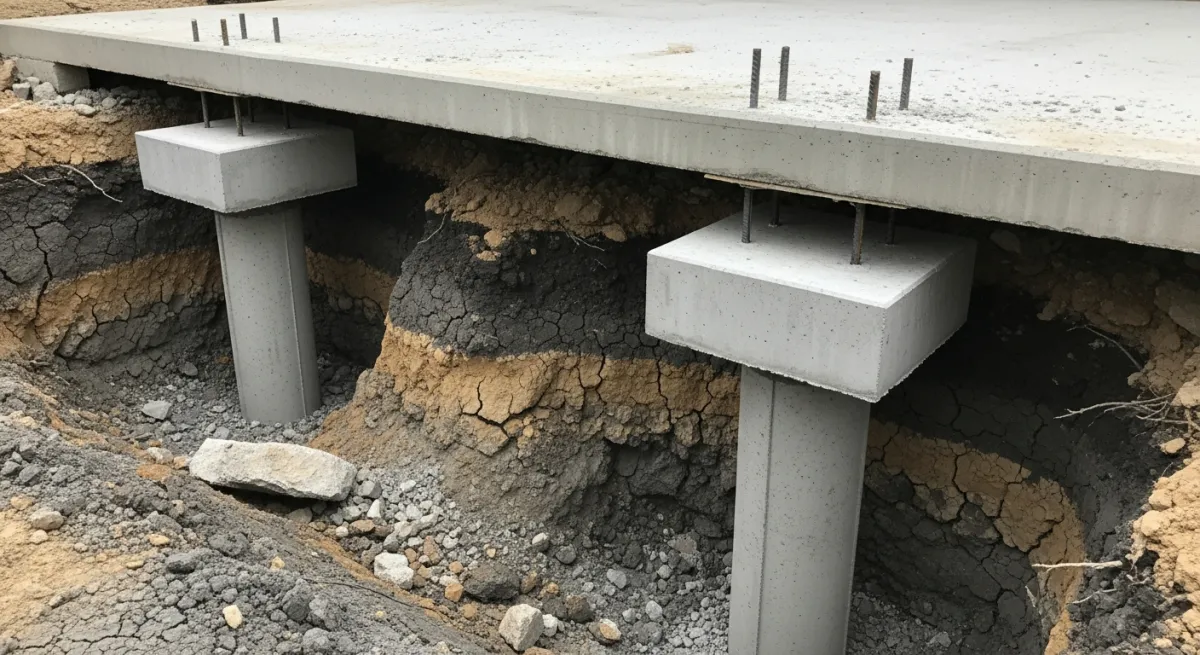
Steel push piers are hydraulically driven segments of steel pipe pushed down through the clay until they reach bedrock or a load-bearing stratum. They run $1,200 to $1,800 installed in the Austin market. Because Blackland Prairie clay is expansive, Austin engineers frequently specify higher pier densities than markets with less active soils — which translates directly into higher pier counts and higher total costs. A number you found on a national home improvement aggregator is almost certainly too low.
Helical piers work differently. They’re screwed into the ground using a torque motor, and load capacity can be verified in real time by monitoring installation torque. That’s a meaningful quality-assurance advantage over push piers — you’re not guessing whether the pier is doing its job. They’re the preferred system when load-bearing strata is shallower or when push-pier vibration could cause additional damage. In Austin, helical piers run $1,500 to $2,500 per pier installed.
Pressed concrete piers — also called segmental or concrete cylinder piers — are the cheapest option at $300 to $500 per pier, and volume repair companies in Texas lean on them heavily. They work by pressing pre-cast concrete cylinders into the ground in stacked sections. The problem is they rely on friction in clay soil to hold. In a severe drought cycle, when clay dries and pulls away from the pier, they can lose capacity. My read, after looking at how often they appear in warranty disputes: they’re not fraudulent, and they’re appropriate for certain budgets and site conditions, but if a contractor is offering pressed concrete piers on a severe-settlement job without explaining why that’s the right call, push back. The gap between a pressed concrete pier warranty and a steel pier warranty is often larger than the gap in price.
Among the established contractors active in this market, HD Foundations, Perma-Pier Foundation Repair, Olshan Foundation Solutions, and RAM Jack Central Texas handle a significant volume of Austin-area work. Before signing anything, get itemized bids from at least three companies and verify pier type, per-pier pricing, and target depth in each. An itemized bid is non-negotiable.
Slab vs. Pier-and-Beam: Two Different Repair Economies
Austin’s housing stock divides into two foundation types with very different repair logic. In Hyde Park, Travis Heights, Clarksville, Bouldin Creek, the South Congress bungalow corridor, and most inner East Austin neighborhoods built before 1960, the dominant type is pier-and-beam. The house sits on a network of wood beams supported by concrete or steel piers, with a crawl space between the floor system and the ground. Post-1980s development in Round Rock, Cedar Park, and Pflugerville uses almost uniformly post-tension slab-on-grade — a poured concrete platform with embedded steel cable tendons that resist cracking.
Pier-and-beam re-leveling is more accessible than slab repair. A contractor can physically enter the crawl space and assess beam and joist condition directly. They jack the structure back to level by shimming or replacing individual wood posts or adding steel footings. For a typical pier-and-beam bungalow in Travis Heights or Hyde Park, re-leveling costs run $2,000 to $8,000 depending on settlement severity and whether any framing needs replacement. These older foundations are also more forgiving of soil movement than slabs — they have more inherent flex, which is part of why so many inner-Austin houses are still standing and livable despite decades of Blackland Prairie clay doing its thing underneath them.
Post-tension slab repair is a different category of problem entirely. A post-tension slab has steel tendons under tension running through the concrete. Cutting into one during pier drilling is a serious structural event requiring immediate remediation — not the kind of surprise anyone wants mid-job. Any contractor working on a post-tension slab should be able to identify tendon locations before drilling begins. This is not the job where you hire based on the lowest bid.
Is It Serious? Reading the Warning Signs Before You Call Anyone
The honest answer to “is this crack an emergency?” is almost certainly no. But it might matter, and you should be able to read the situation yourself before a contractor tells you what to think.
Hairline cracks in drywall at wall-ceiling joints or at the corners of door and window frames are extremely common in Central Texas and usually reflect seasonal movement rather than structural settlement. Small grout gaps in tile floors, particularly if evenly distributed, fall into the same category. Doors that stick in summer and free up in cooler weather usually reflect humidity-driven wood swelling, not foundation failure. Exterior caulk cracking around windows or trim is cosmetic.
Stair-step cracking in brick or masonry is different. Diagonal cracks following the mortar joints in a staircase pattern indicate differential settlement and warrant a closer look. So do interior doors that have stopped latching and don’t improve across seasons, visible gaps between the slab and brick veneer at the base of an exterior wall, and floors with a measurable slope you can verify with a level. Cracks in drywall that are noticeably wider at one end than the other indicate active movement — the tapering matters. Any crack you can see through to daylight, or that has a corresponding crack on the opposite side of the wall, deserves professional assessment.
Before you sign any repair contract, pay for an independent assessment from a licensed structural engineer. Not the contractor’s in-house engineer. Not the free inspection the contractor offers. A licensed Professional Engineer registered in Texas, with experience in residential geotechnical work, will charge $300 to $700 for a residential foundation assessment. That report tells you what the problem actually is, what repair method is appropriate, and roughly how many piers are needed and where. It gives you a benchmark against which to evaluate every bid you receive and protects you against being oversold. Worth every dollar.
Most Austin foundation movement is gradual. A house that has been slowly settling for years is not at risk of sudden catastrophic failure. There is almost never a reason to sign a repair contract on the same day as an inspection. If a contractor is pushing you to do exactly that, slow down.
The Permit Question Most Homeowners Miss
The City of Austin Development Services Department requires a building permit for structural foundation repair. This isn’t a technicality that contractors routinely waive — it’s a legal requirement, and unpermitted foundation work creates real problems at resale that land on you, not the contractor.
Under the TREC Seller’s Disclosure form that Texas law requires in most residential transactions, sellers must disclose known foundation repair. If that repair was done without a permit, a buyer’s inspector will often identify it through visible evidence. New pier caps, disturbed soil, concrete patches — they tell the story. An unpermitted repair becomes a flag in the transaction. I’ve heard this story enough times that it’s not really an edge case: the seller ends up negotiating against the repair cost twice — once when they paid for it and again when it comes up in the transaction. For a broader look at how foundation repairs and other improvements affect what buyers will pay, home improvements and resale value in Central Texas is worth reading before you commit to a scope of work.
Some contractors skip the permit because it reduces their apparent bid cost and speeds up their scheduling. But a low bid that omits permitting isn’t actually a lower cost to you. It’s a deferred cost transferred from their overhead to your disclosure obligation at resale.
For properties in Travis County’s unincorporated ETJ areas — portions of Pflugerville, Manor, Jonestown, and unincorporated Travis County outside city limits — permit jurisdiction falls to Travis County rather than the City of Austin. The requirement still applies; the issuing authority differs. Contractors who tell you “we’re outside city limits, permits don’t apply” are either misinformed or being misleading. Ask any contractor before signing: “Will you pull the permit, and can you show me the permit number after it’s issued?” If the answer is no, treat that as disqualifying.
Vetting Austin Foundation Contractors
Texas has no specific license category for foundation repair contractors. Any general contractor can legally perform foundation repair work in Texas. The Texas Residential Construction Commission, which provided some regulatory oversight, was abolished in 2009. That gap in consumer protection has never been closed. This matters because “licensed contractor” in advertising means less than you’d hope — it typically refers to a general contractor license, not any foundation-specific credential.
What actually matters is the engineer behind the repair plan. Any reputable foundation repair company working in Travis County should involve a Texas Board of Professional Engineers-licensed structural engineer in the design — specifying pier type, depth, spacing, and load calculations. Ask to see the engineer’s stamp on the repair plan. If the company doesn’t use a licensed engineer to spec the work, that’s a meaningful gap.
The Better Business Bureau’s Austin chapter has records on most area contractors. More useful than the letter grade is the complaint detail. Look for patterns around warranty disputes, incomplete work, and high-pressure sales tactics. The Texas Attorney General’s Consumer Protection Division maintains a complaint database that foundation repair contractors appear in with some regularity. A 10-minute search before you sign anything is worth your time before committing to a five-figure repair.
On warranties: many foundation repair companies advertise “lifetime warranties,” and the details matter quite a lot. A lifetime warranty that terminates at sale is worth nothing to you in a market where where most people move within five to ten years. A transferable lifetime warranty that a subsequent buyer can rely on is an actual asset at resale. Get the warranty terms in writing and read them — all of them.
The distinction between a free contractor inspection and an independent engineer assessment cannot be overstated. A contractor’s free inspection is a sales call. The inspector’s job is to identify work to sell you. That doesn’t necessarily make their assessment wrong, but it means you have no way to calibrate it without an independent data point. Pay the $300 to $700. Everything else follows from that.
Contract Red Flags Specific to Texas Foundation Repair Bids
Getting three bids is necessary but not sufficient. What you’re comparing across those bids matters as much as the total numbers.
Many Texas foundation repair warranties include a clause requiring the homeowner to maintain consistent soil moisture around the foundation perimeter as a condition of coverage. The engineering principle is legitimate. But these clauses are often written so broadly that any subsequent settlement can be attributed to “failure to maintain adequate moisture,” which voids the warranty. A clause that voids coverage if you fail to water during drought conditions is a very different animal from one that voids coverage only upon documented evidence of severe, unusual drying. They can look similar in a sales pitch. Read the specific language.
A non-transferable lifetime warranty is marketing, not a guarantee. A bid that gives you a total number without specifying pier count, pier type, installation depth, and locations is not a real bid — it’s a number you can’t evaluate or compare against anything. Require itemization. Any legitimate contractor can provide it.
Pressed concrete piers and steel piers perform differently in expansive clay under drought conditions. A contract that describes them interchangeably, or simply says “piers” without identifying the system, obscures something you’re entitled to understand before you sign.
Pressure to decide immediately is documented in AG complaints about foundation repair companies — “the discount expires Friday,” “I can fit you in tomorrow but not next week.” Legitimate contractors are typically booked weeks out. They’re not hunting for next-day availability. If a contractor needs your answer today, that’s a reason to slow down, not speed up.
Timing Your Repair
There’s a right season to do foundation repair work in Austin, and it’s not summer.
Post-drought summer is the worst time. Contractor demand surges, driving up prices and wait times. The soil is at its driest, conditions aren’t stable, and you’re competing with every other homeowner who just noticed their door won’t close.
Structural engineers working this market consistently recommend planning repairs for late fall through early winter — October through December — after the first significant rains have begun to rehydrate the soil. Soil at equilibrium moisture gives piers a stable starting condition and allows post-repair monitoring under realistic conditions. It also puts you ahead of the spring demand surge. Timing alone can affect what you pay.
The soaker hose question gets dismissed as contractor myth more often than it deserves. The principle is sound: consistent perimeter soil moisture reduces the differential drying that drives shrink-swell movement. Running a soaker hose at the foundation perimeter during dry periods is professional advice grounded in geotechnical engineering, not sales pitch.
The Austin-specific complication: during drought water restrictions under Austin Water’s conservation program — which have historically reached Stage 4 during severe droughts — outdoor watering schedules are restricted. A regular soaker hose program may conflict with those rules. Check the current restriction stage at the Austin Water conservation page before committing to any watering schedule. And here’s a detail worth flagging: a warranty requiring regular soaker hose use may be creating an obligation you legally cannot meet during declared water emergencies. Read that warranty clause with Austin’s water restriction history in mind. It’s not a hypothetical.
Ten Questions to Ask Before Signing Any Austin Foundation Repair Contract
-
Will you pull a City of Austin (or Travis County, if applicable) building permit for this work, and can you provide the permit number before work begins?
-
Is a TBPE-licensed structural engineer involved in designing the repair plan, and will I receive a stamped engineering drawing?
-
What pier type are you specifying — steel push pier, helical pier, or pressed concrete — and why is that the right system for my specific site conditions?
-
What installation depth are you targeting for each pier, and what load-bearing stratum are you designing to reach?
-
How many piers are in this bid, and can you provide a pier location diagram?
-
Is the warranty transferable to a subsequent buyer, and what is the specific language around soil moisture maintenance?
-
Does the warranty include any clause allowing you to deny a claim based on failure to maintain a watering program? If so, what documentation would I need to show I complied?
-
What happens if you drill and encounter unexpected conditions — deeper bedrock, subsurface voids, or post-tension tendons? How are change orders handled, and are they capped?
-
Can you provide references from jobs in my specific neighborhood or zip code, where soil conditions are comparable to mine?
-
Have you had complaints filed with the Texas Attorney General’s Consumer Protection Division or the BBB in the past three years?
One More Thing Before You Sign
The 2022–23 drought opened this conversation across the Austin metro in ways that probably permanently raised homeowner awareness of foundation risk. That’s mostly a good thing. An informed homeowner who gets an independent engineering assessment, reads warranty language carefully, and insists on a permitted repair is a much harder target for the contractors who rely on pressure tactics and warranty clauses written to be uncollectable.
Here’s the baseline reality of owning a home east of MoPac: your house almost certainly moves seasonally. It has moved since it was built. At some point in its life, it will probably need some form of foundation work. That’s not a scare tactic — it’s what montmorillonite clay does, and the Blackland Prairie doesn’t care what your mortgage rate is. For context on what all this means for your property’s value relative to the broader market, our home & property coverage tracks Austin real estate conditions, resale factors, and cost topics across the metro.
The $300 to $700 for an independent structural engineer before you commit to any large repair is still the single best money you can spend in this process. Get that report first. Everything else — the bids, the pier type, the warranty negotiation — you’ll be in a much better position to handle once you know what you’re actually dealing with.