What a Summer Home Inspection in Austin Should Catch That Others Miss
Buying a house in Central Texas in July or August means you're closing during the worst heat of the year, which most buyers experience as a nuisance. The smarter frame: summer is actually the most …

What a Summer Home Inspection in Austin Should Catch That Others Miss
Buying a house in Central Texas in July or August means you’re closing during the worst heat of the year, which most buyers experience as a nuisance. The smarter frame: summer is actually the most revealing time to inspect an Austin home, if your inspector knows what to look for.
The AC is running under real load. The attic is brutal. The clay soil has been baking and shrinking for two months. Every system that struggles in this climate is struggling right now, in front of you.
The problem is that the standard TREC inspection checklist—the floor your inspector is legally required to meet—was written for the whole state of Texas. Not specifically for the Blackland Prairie clay, the aging sewer pipes under South Congress bungalows, or the garage conversions in Cherrywood that went up after Austin loosened its ADU rules. What your inspector is required to look at and what you actually need them to look at are not the same list. This guide closes that gap.
Verify Your Inspector Before You Do Anything Else
Texas requires all practicing home inspectors to hold a license through the Texas Real Estate Commission. Two tiers exist: Professional Inspector (the full credential) and Real Estate Inspector (a supervised, junior designation). Both are searchable at license.trec.texas.gov—a five-second check that buyers routinely skip. Do the five-second check.
You want a Professional Inspector, not someone working under supervision.
What that TREC license does not require is errors-and-omissions insurance. E&O coverage protects you if the inspector misses something significant and you end up with the repair bill. Texas inspectors aren’t legally required to carry it—which sounds fine until it isn’t. Ask directly before you hire anyone: Do you carry E&O insurance, and what are the coverage limits?
Beyond the license, look for actual Austin market depth. The Texas Association of Real Estate Inspectors maintains a member directory at tarei.org, and membership there often signals someone who takes continuing education seriously. More to the point: an inspector who has spent a decade working Travis, Williamson, and Hays counties has watched what black gumbo clay does to a slab over thirty years of drought-and-recharge cycles. A generalist who came up in Houston or Dallas has not. That difference matters more than most buyers realize—Austin’s failure modes are specific to Austin.
When you’re vetting inspectors, ask them: How many inspections have you done in this zip code? What do you typically find on post-tension slabs in this market? How do you approach hail assessment? You’ll know within two answers whether you’re talking to someone who knows Austin or someone who knows inspections in the abstract sense.
Why Summer Conditions Work in Your Favor
Most buyers treat summer inspections as an inconvenience. July and August give you diagnostic advantages that a December inspection can’t.
When outdoor temperatures sit in the upper 90s and low 100s, the AC runs continuously during your inspection. Your inspector can measure the supply and return air temperature differential—typically 15 to 20 degrees Fahrenheit in a functioning system—while the equipment is under real load. In winter, you’re running a simulated cooling test in mild conditions. You learn almost nothing about whether the system can actually hold 75 degrees in a 2,000-square-foot house when it’s 104 outside. In summer, you find out immediately.
Attics are even more revealing. An Austin attic in July routinely hits 130 to 150 degrees. That heat exposes insulation failures, inadequate ridge ventilation, and improperly installed radiant barriers in ways a January inspection simply won’t. If your inspector is spending three minutes up there because it’s miserable, ask whether they got a real look at the ridge vent situation and insulation depth at the perimeter. Three minutes isn’t enough.
One honest trade-off: grading and drainage problems that become obvious during fall rains are harder to see in July. But dry conditions reveal foundation stress from a different direction—the shrinkage side of Austin’s clay expansion cycle, which tells you a lot about long-term performance.
Austin’s Foundation Reality
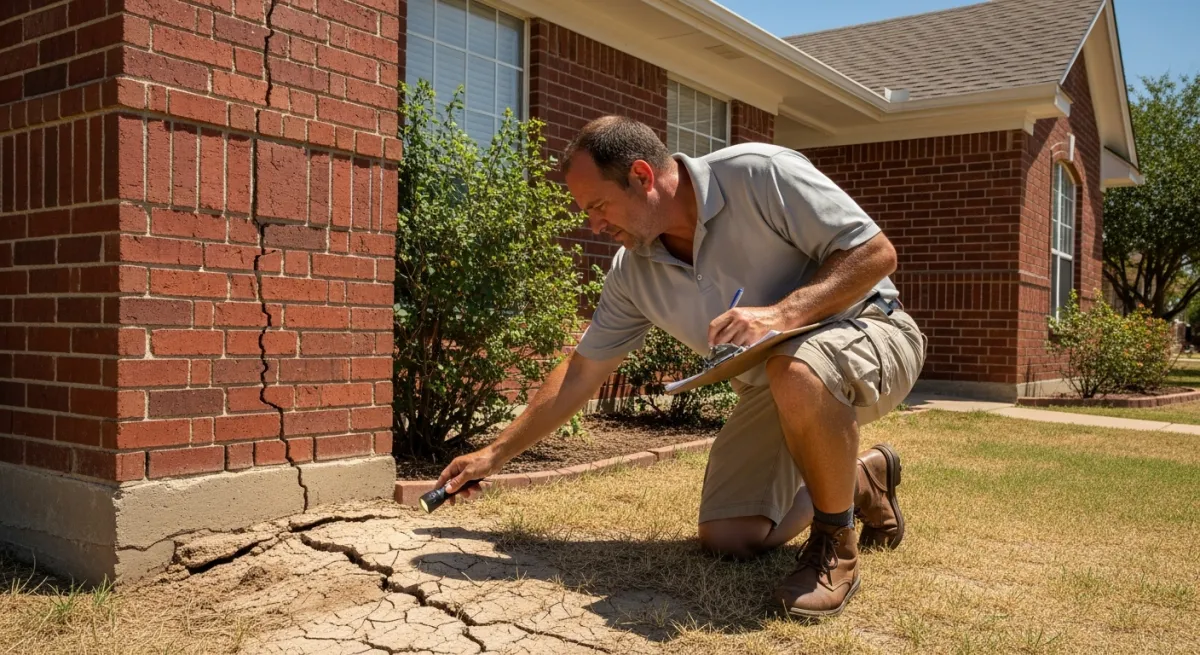
No single issue drives more repair spending in this market than what the soil does to foundations. The Blackland Prairie Vertisol and Houston Black clay soils running through Travis, Williamson, and Hays counties are among the most expansive in the country. In dry summers they shrink and pull away from foundation perimeters. When fall rains arrive they swell and push back. Decades of that cycle stress both slab-on-grade and pier-and-beam foundations in ways that are specific to Central Texas.
A competent inspector reads these signs correctly. Not every crack is a crisis.
Hairline cracks at door corners, seasonally sticky interior doors, minor separation at baseboards—these are extremely common in Austin homes and usually reflect seasonal soil movement. They belong in your inspection report as negotiating material, not as reasons to walk away from an otherwise solid house. But stair-step cracking in brick veneer wider than a quarter inch, wall-to-ceiling separations in multiple rooms, doors that have been cut down to fit (a classic tell of long-term settlement), and floors with real slope require a different response. Stop. Get a licensed structural engineer involved before you proceed. An inspector flags the concern; an engineer tells you whether it’s a deal-breaker. Don’t fudge that distinction.
Post-tension slabs dominate Austin homes built after roughly 1980. High-strength steel cables tensioned through the concrete make the slab behave differently than traditional reinforced concrete. Your inspector should identify post-tension construction and flag any evidence of penetrations or modifications that weren’t original—utilities added through the slab, plumbing runs that required drilling, holes that interrupt the tension cables. Anyone who’s seen one of these go wrong knows why it matters.
When a seller hands you a “transferable foundation repair warranty,” read it carefully rather than exhaling. What repairs were done, by whom, when? Does the warranty actually transfer, or does it require a fee and re-inspection to activate? Has the house been re-leveled more than once? Repeated leveling on the same house is a different situation than a single repair with no recurrence.
Hail Damage You Cannot See From the Driveway
Austin sits on the southern edge of Hail Alley, and the I-35 corridor has taken repeated significant hits. The April 2016 storm caused widespread damage across north Austin and Round Rock. A May 2024 storm tracked through Travis and Hays counties and generated insurance claims across multiple zip codes. The problem for buyers is that hail-damaged roofs often look intact from street level. They may have passed casual visual inspection during previous sales without anyone catching the damage.
What your inspector needs to find is on the roof surface itself and on the soft metals around it. On asphalt shingles, hail damage presents as bruising—a soft spot beneath the granule surface where the impact disrupted the mat without creating an obvious hole. You cannot see bruising from a ladder at the eave. The inspector needs to walk the roof and feel for it. If yours won’t go up there, that’s worth knowing before you hire them.
Ridge caps are another tell: their raised exposure makes them especially vulnerable. Dented or cracked ridge caps on an otherwise clean roof are a red flag.
The most reliable proxy that buyers and many inspectors miss is the soft metals. Aluminum gutters, AC condenser fins, flashing around pipe boots and skylights—these dent clearly and permanently when struck by hail. They don’t get repaired the way shingles sometimes do. If the gutters show a pattern of small, rounded dents consistent with hail impact and no insurance claim appears on the property’s history, that mismatch is worth a conversation.
Ask your inspector whether they have hail-specific continuing education through ASHI or InterNACHI. It’s a legitimate specialty and not everyone pursues it.
Also request a CLUE report—Comprehensive Loss Underwriting Exchange—before you close. It shows insurance claims filed on the property. If a significant hail storm hit the neighborhood and this property shows no claim, it could mean the damage wasn’t caught, the prior owner paid out of pocket, or the roof was replaced without documentation. Any of those warrants a conversation with the seller and probably a roofer who can give you an honest read on remaining life.
How to Pull Austin Permit Records Before Your Option Period Expires
One of the most common problems in Austin’s resale market is unpermitted work—additions, conversions, improvements that were built without permits or with permits that were never finaled. Austin’s permit records are publicly searchable. Most buyers don’t look them up until a problem surfaces, usually after the option period has already run out.
Pull them early. Seriously.
Austin Explorer at austintexas.gov allows address-level permit history searches and Certificate of Occupancy status checks. Austin Build + Connect has more detailed documentation on individual permits, including inspection records and permit type.
You’re looking for any permit opened after the original CO date—additions, garage work, bathroom additions, deck construction, ADUs—matched against whether a final inspection was ever completed. A permit with no final inspection recorded is not a closed permit. It means the work was started and never approved.
The phrase to know is “permit opened, no final.” It shows up repeatedly in East Austin flips, Rundberg-area rental conversions, and Hyde Park properties where someone added a bathroom somewhere in the last twenty years. It sounds like a technicality. It is not.
The ADU situation deserves specific attention. Austin liberalized its accessory dwelling unit rules in 2019 and again in 2023. That triggered a wave of garage conversions and backyard cottage construction across Cherrywood, Holly, and the South Congress corridor, and a meaningful share of those units were built without permits or with permits that were never finaled. As covered in our home & property coverage, these regulatory details have real financial consequences for buyers navigating Austin’s resale market. An ADU without a proper CO cannot legally be marketed as rentable square footage. A buyer who tries to rent it may face city enforcement. Unpermitted construction may also fall outside your homeowner’s insurance coverage if something goes wrong. For the full picture on what’s allowed and what it costs, see what Austin’s ADU rules actually allow and what it really costs to build one. Pull the records yourself. It takes fifteen minutes and it needs to happen before your option period expires.
Drainage and Grading Problems Buyers Miss Every Summer
The dry July and August conditions that make summer convenient for showings also flatten the visual evidence of grading failures—the ones that funnel water toward foundations during fall and winter rains. You can’t stand in a yard in August and watch water pool against the foundation. But your inspector can still identify the conditions that cause it, and that conversation needs to happen explicitly, not as a buried line item in a 60-page report.
Slope toward the foundation perimeter is the core problem. Your inspector should be verifying that finished grade falls away from the structure, using eyes and a level where necessary. Compacted fill soil around newer construction and remodeled properties can prevent infiltration even when grade appears correct. Downspout discharge pointed directly at the foundation or toward a neighbor’s property line appears in Austin inspections more than it should.
Here’s what makes this worse in Austin than in most markets: improper drainage doesn’t just cause moisture intrusion. It accelerates the wet-dry expansion cycle in the clay soil that’s already stressing your foundation. Every time water concentrates near the perimeter of a slab on Blackland Prairie clay, the soil swells unevenly. Every summer that perimeter dries and shrinks, it pulls down. Run that cycle for fifteen years under a foundation that was never graded properly and you’re looking at foundation repair costs that dwarf what a drainage correction would have cost at the outset.
When you’re debriefing with your inspector, ask directly: If this property gets four inches of rain in a week, where does the water go? That question tends to produce more useful answers than waiting to see whether drainage makes the written report.
The Add-On Inspections the Standard TREC Scope Leaves Out
The standard Texas home inspection is governed by 22 TAC Chapter 535, Subchapter U. It’s a solid floor. It is not a ceiling. Several significant systems fall outside that scope, and in Austin, several of those gaps create real exposure for buyers who assume the standard inspection covered everything.
Central Austin’s older neighborhoods—Hyde Park, Rosedale, Brentwood, Travis Heights, most of 78704 and 78751—sit on aging cast-iron and clay sewer pipe. These pipes move with the soil. They crack, offset, accumulate root intrusion. A sewer scope runs a camera from the cleanout to the city connection and takes maybe an hour. On any pre-1980 Austin home, this is essential due diligence. No exceptions.
Termite and wood-destroying organism inspection is a separate licensed field in Texas, requiring a Texas Department of Agriculture license distinct from the TREC credential. Formosan termites are an expanding presence in Central Texas; unlike native subterranean termites, Formosans build aerial colonies and cause damage faster and higher in a structure. Termite activity peaks in summer when swarmers are active. Most sellers expect a WDO inspection anyway.
If the property has a pool—common in 78704, 78746, and hill country edge neighborhoods—the pool is outside the standard inspection scope. A licensed pool inspector checks equipment, plumbing, coping, shell integrity, and the barrier and safety compliance Austin’s code requires. Deferred pool maintenance and equipment replacement can run well into five figures. Budget accordingly.
Properties in Dripping Springs, Buda, and Kyle, and most of the outer-ring areas beyond Austin’s water service territory, frequently run on septic systems and draw from private wells. Neither falls within the standard TREC scope. Both are essential on rural and semi-rural properties. Don’t treat them as optional.
A Neighborhood Guide to Austin’s Dominant Inspection Concerns
Different parts of the Austin market have failure modes tied to when they were built and what’s happened to them since.
Hyde Park, Brentwood, Crestview, and Travis Heights are dominated by pier-and-beam foundations from the pre-1960s era. They’re more repairable than post-tension slabs but more vulnerable to crawl space moisture and wood deterioration. The inspection should include a thorough crawl space evaluation: moisture levels, beam condition, joist integrity, signs of pest damage. Electrical wiring in homes of this vintage may include original knob-and-tube or early panel configurations that create insurance and safety issues. Cast-iron drain lines are nearly universal, so the sewer scope is non-negotiable. You’re specifically looking for the combination of age and moisture exposure that produces wood rot and termite risk.
The South Congress corridor, Zilker, and Barton Hills mix construction eras with heavy renovation activity. These are some of the most actively flipped zip codes in the city, which means the permit record check matters more here than almost anywhere else. Cosmetic renovation is easy to see; unpermitted structural work is not. Watch for bathroom additions that feel slightly off from the original construction, square footage that doesn’t match appraisal district records, and garage conversions with HVAC added after the fact. These neighborhoods have earned their scrutiny through experience.
Mueller, East Riverside, and Domain-adjacent properties from the 2000s through 2020s are newer but not trouble-free. Post-tension slabs are universal here. Builder-grade HVAC equipment is a recurring problem—I’ve seen 15-year-old units in these neighborhoods that were undersized from day one, grinding through Austin summers on borrowed time. Attic ventilation shortcuts, particularly insufficient ridge venting across large roof planes, are common. The homes are recent enough that buyers sometimes lower their guard. Don’t.
Cedar Park, Round Rock, Pflugerville, and Georgetown suburbs from the 1990s through 2010s feature brick veneer over wood frame on the same expansive Blackland Prairie clay soils as Austin proper. This is where stair-step brick cracking shows up most consistently. The I-35 corridor through Williamson County has taken repeated hail hits. Radiant barriers installed without an air gap—foil that traps heat instead of reflecting it—appear in attics throughout the 2000s boom-era construction here. Drainage grading on large subdivision lots is frequently marginal because the original builders moved fast. If you’re weighing a purchase in one of these suburbs, the real cost breakdown for Kyle, Pflugerville, and Hutto is worth reviewing before you finalize your numbers.
Dripping Springs, Buda, and Kyle require a different baseline. The standard inspection still applies, but the critical add-ons here are septic evaluation and well water quality testing, full stop. Hilly terrain also creates drainage complexity that flat Central Austin lots don’t have. Water routing around structures needs specific attention, not a glance.
What to Do With All of This Before You Close
The standard inspection is a starting point, not the finish line.
Pull the permit records yourself at Austin Explorer before your option period expires. Ask your inspector directly about their Austin market experience, their hail assessment background, and how they approach post-tension slabs and drainage. Budget for the add-on inspections that your property’s age, location, and features actually call for—not the ones that feel optional until they’re not.
If the foundation report gives you pause, a structural engineer’s evaluation before you proceed is cheap compared to inheriting a repair you should have negotiated or walked away from.
Summer conditions give you real information. The AC is running. The attic is at maximum stress. The clay soil has been shrinking for two months. Use all of it.