What $450K Actually Buys in Leander or Cedar Park Right Now
From school district boundary traps to MetroRail math, here's the side-by-side breakdown families need before they sign.

From school district boundary traps to MetroRail math, here’s the side-by-side breakdown families need before they sign.
The two cities sit about ten miles apart on the northern edge of the Austin metro, share Williamson County, and appear on the same map of “affordable suburbs worth considering.” That’s where the similarities end.
Leander and Cedar Park diverge sharply on price per square foot, property tax burden, school district assignment, commute infrastructure, and basic daily livability. Families who treat the choice as a coin flip often discover the gap only after they’ve closed. By then it’s mostly just painful.
This piece judges both cities on four criteria that actually move the needle for families relocating to the Austin area: home value, schools, commute, and walkability. The goal isn’t to declare a winner. It’s to help you figure out which city fits your specific situation before you’re negotiating an offer.
What $450K Buys, Side by Side
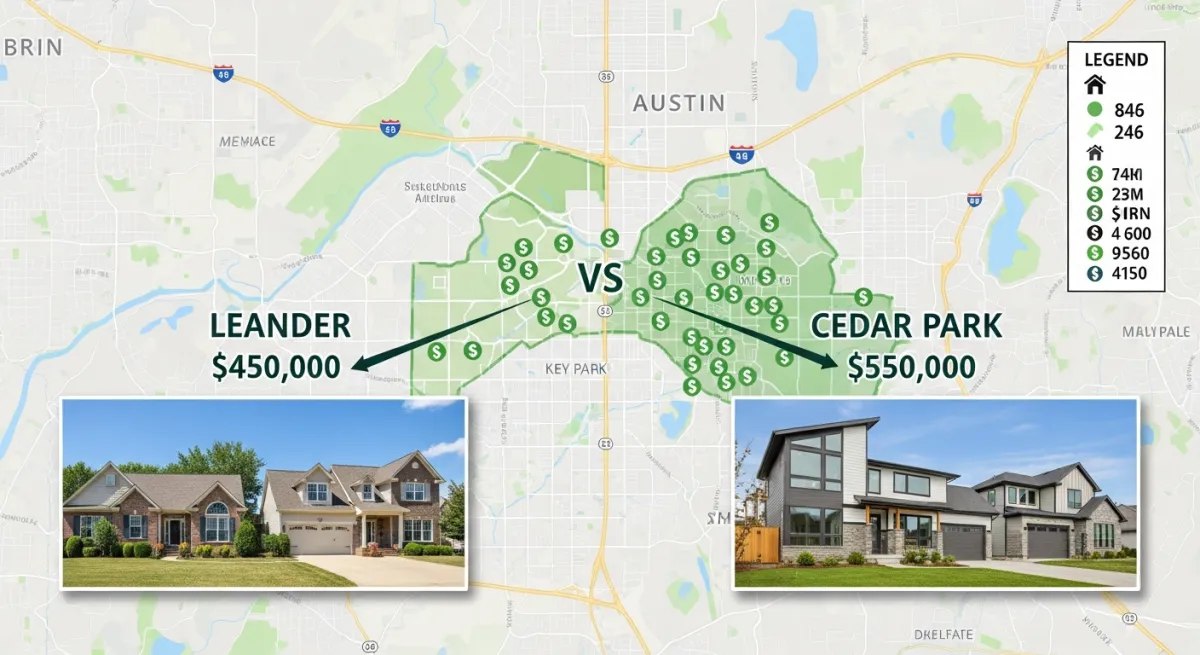
Start with the headline numbers. Leander is running roughly $185–$210 per square foot on active and recently closed sales. Cedar Park is coming in higher, around $205–$235. That spread sounds modest until you apply it to a $450,000 budget.
At $195 per square foot in Leander, $450K gets you around 2,300 square feet. At $220 per square foot in Cedar Park, that same budget yields closer to 2,045. For a family that needs four bedrooms, that gap often determines whether a bedroom can double as a home office. Two hundred fifty square feet doesn’t sound like much until you’re living in it.
The more consequential difference is what kind of home your money buys. In Leander, $450K lands you in the new-construction market. Pulte, Lennar, Taylor Morrison, and David Weekley are actively selling in Bryson, Larkspur, and Kristin Ranch. In a market that has cooled considerably from the 2021–2022 peak, many of those builders are negotiating — rate buydowns, appliance packages, upgrade credits. These are real options right now, not wishful thinking. A buyer with $450K and patience has genuine room to move at the Leander sales office in a way that simply doesn’t exist in Cedar Park.
Cedar Park at $450K is almost entirely a resale play. Inventory is tighter, sellers know it, and homes at this price tend to be older stock in established neighborhoods like Ranch at Brushy Creek or Buttercup Creek. These have mature trees and settled infrastructure, which is genuinely appealing — but buyers should budget for deferred maintenance and negotiate off the home, not off a builder’s incentive sheet.
Days on market across both cities have extended considerably compared to two years ago. Homes are sitting 30–60-plus days rather than the single-digit DOM of 2022, which still feels strange to anyone who tried to buy here during the frenzy. In Leander new construction, you may also be waiting on a build timeline depending on how early you contract. For a broader view of how price shifts are playing out across the region, Austin home prices by ZIP code in 2026 show which corridors are gaining and which are cooling.
Prices here reflect recent market conditions and should be checked against current ABOR MLS data before any purchase decision.
The Hidden Cost That Doesn’t Appear on the Listing Sheet
Before you convert that price-per-square-foot advantage in Leander into a purchase decision, run one more calculation that most buyers skip — and, honestly, a surprising number of buyer’s agents too. It’s the Municipal Utility District tax rate.
Leander’s newer growth corridors, particularly west of 183A, were developed through MUD financing. A MUD issues bonds to pay for the water, wastewater, and drainage infrastructure a new subdivision requires. Those bonds get repaid through a MUD tax rate layered on top of everything the homeowner already pays. In active Leander MUDs, those rates currently run roughly $0.20–$0.40 per $100 of assessed valuation.
On a $450,000 home assessed at full value, that’s an additional $900 to $1,800 per year. Call it $75 to $150 per month, stacked on top of city, county, and school district rates you were already factoring. It won’t sink a purchase. But it’s real money — the kind that quietly erases part of the square-footage advantage you thought you were getting.
Here’s the full picture. A Leander home in a newer MUD-served subdivision carries Williamson County, City of Leander, Leander ISD, and MUD rates. The base combined rate before any MUD addition typically runs around $2.00–$2.40 per $100 of valuation. Add the MUD on top, and far-western Leander subdivisions can push toward the high end of that expanded range and beyond.
Cedar Park’s established neighborhoods tell a different story. In Buttercup Creek, Ranch at Brushy Creek, and neighborhoods along Whitestone, many original MUD bonds have been paid down or retired. Buyers there often face no additional MUD layer at all.
How do you check? Pull the property’s account on the Williamson County Appraisal District website and look at the full tax rate breakdown for that specific parcel. Every taxing jurisdiction that applies to that address is listed there. Do not rely on what a listing sheet says. Don’t trust what a builder’s sales rep quotes you. Pull the actual WCAD account record. It takes a few minutes and can save you from an unpleasant conversation at the closing table.
One item of genuine relief for buyers coming from out of state: Texas enacted a $100,000 homestead exemption on school district taxable value in 2023, up from $40,000. On a $450,000 home, that reduces the taxable value for LISD or Round Rock ISD purposes to $350,000. Real savings — though not enough to close the gap between a high-MUD address and a no-MUD address. Understanding the full scope of what the Travis County homestead exemption covers can help buyers from outside Texas calibrate these offsets before they commit.
MUD rates should be confirmed against current WCAD records for any specific subdivision before closing.
The School District Boundary Problem Nobody Warns You About
Here is the single most misunderstood fact in Cedar Park and Leander real estate, and it costs families real grief every year: Cedar Park High School is in Leander ISD. A large portion of Cedar Park addresses feed into Leander ISD, not Round Rock ISD.
The practical district geography divides roughly along US-183. Round Rock ISD generally covers eastern Cedar Park east of the 183 corridor. Leander ISD covers the City of Leander and western Cedar Park. This means a family who buys in Cedar Park assuming they’re getting Round Rock ISD schools may discover — during inspection or after closing — that their children will attend Leander ISD campuses instead. I’ve heard this described as a gut-punch moment, and I believe it.
City name is not a reliable proxy for school district assignment. Both districts operate campuses within Cedar Park.
On the Round Rock ISD side, communities in eastern Cedar Park feed campuses including Fern Bluff Elementary, Reed Elementary, Cedar Valley Middle School, and McNeil High School. Round Rock ISD has historically carried stronger aggregate TEA accountability ratings. It benefited from decades of established suburban development and built institutional capacity ahead of major growth pressure.
On the Leander ISD side, campuses serving Leander proper and western Cedar Park include Akin Elementary, Camacho Elementary, Running Brushy Middle School, and Vista Ridge High School. LISD has improved its TEA standing in recent years. Vista Ridge is a comprehensive high school with competitive programs. But the district is under real growth pressure — newer west-Leander elementary campuses are managing enrollment with portable classrooms while permanent capacity catches up, and attendance zone boundaries have been redrawn multiple times as growth accelerated. That’s the reality of building a school system for a city that added population faster than bond cycles can fund construction. It’s worth naming plainly.
The practical instruction is simple: don’t rely on a neighborhood name, a builder’s marketing materials, or a Realtor’s verbal confirmation. Go to the Round Rock ISD and Leander ISD websites — both have address-specific school locator tools — and run your street address before your inspection period closes. If you’re still in the option window, you have choices. If you’re past it, you don’t.
TEA accountability ratings should be checked at tea.texas.gov before any decision weighted on district performance.
Does Living Near the Leander MetroRail Station Actually Save You Money?
The Leander Station is a genuine asset. It’s also a more limited one than suburban real estate marketing tends to imply.
CapMetro’s Red Line runs weekday peak service only — roughly five to six AM departure windows heading south, five to six PM windows heading north. No all-day service. No weekend service. The train doesn’t run if your meeting ends at 3 PM, and it doesn’t run Saturday morning. If you’ve ever built your schedule around a commuter rail timetable, you already know how that particular constraint feels at 2:45 on a Friday.
Travel time from Leander Station to downtown Austin’s Plaza Saltillo or Downtown stations runs approximately 55 to 65 minutes. That’s slower than driving off-peak on a clear morning, and roughly competitive with peak-hour congestion on 183A when tolls are flowing and lanes are stacked. What you’re buying is predictability, not speed.
The financial case, though, is where rail actually earns its value for the right buyer. A monthly CapMetro MetroRail pass runs approximately $100. The monthly cost of driving the equivalent commute — fuel, 183A toll charges, downtown parking — can realistically hit $300–$500. The annual savings range from $2,400 to $4,800. Over five years, that’s $12,000 to $24,000. When you’re also weighing an extra $75 to $150 per month in MUD taxes, that number starts to matter quite a bit.
But the math only works under specific conditions. Your employer has to be near a Red Line stop. The line serves downtown Austin, the MLK/UT corridor, and a handful of intermediate stations. If you work at the Domain, in South Austin, in Round Rock, or at a Cedar Park employer, the Red Line delivers no commute benefit whatsoever. It is a downtown-specific tool for a downtown-specific commuter.
Leander Station’s structural advantage over Cedar Park’s alternative is clear. Lakeline Station sits near the Austin/Cedar Park border area around 183/620. As the northern terminus, Leander is where trains originate — no standing room in the AM, no competition for seats at an intermediate stop. The station’s park-and-ride lot holds roughly 1,000 to 1,200 cars with structured parking. Lakeline is a mid-line stop with more limited parking that requires Cedar Park residents to drive to the Austin border to access it.
If you’re a five-day-a-week downtown Austin commuter who can work within a peak-hour schedule, Leander’s rail access is a real financial and logistical asset worth factoring into the purchase decision. If you’re not, it’s a nice-to-have that shouldn’t anchor your neighborhood choice.
Schedule, fares, and parking capacity should be confirmed at capmetro.org.
Walkability and Daily Life
Cedar Park wins this comparison, and the gap isn’t close.
The 1890 Ranch corridor along US-183 and Whitestone Boulevard is Cedar Park’s de facto town center for daily errands. The H-E-B at 1890 Ranch is one of the higher-volume locations in the metro — if you’ve been there on a Sunday afternoon, you don’t need further explanation. Target, Costco, and a dense strip of national and regional restaurants line the 183/Whitestone area in a way that genuinely reduces how often residents need to leave the city for routine needs.
Cedar Park Town Center, the mixed-use district near City Hall on Whitestone, is a deliberate attempt at a walkable streetscape and has made real progress. Restaurants and small retail have established it as a place people actually go, not just pass through. For active-lifestyle buyers, Cedar Park holds another meaningful advantage: the Brushy Creek Regional Trail, more than 13 miles of genuinely used infrastructure that links residential neighborhoods to parks, creeks, and retail nodes. It makes car-free recreation legitimate for families with kids in a way that most suburban trail systems don’t.
Leander’s retail picture is functionally adequate and strip-mall in character. US-183, Crystal Falls Parkway, and Hero Way carry the groceries, fast food, and big-box retail residents need. The H-E-B on Crystal Falls and newer retail along those corridors keep daily errands manageable. But Leander lacks the restaurant density, the independent retail texture, or the walkable district Cedar Park has built. That’s not where Leander is right now — and that’s not a neutral observation, it’s a genuine daily-life difference depending on what you want.
The Downtown Leander revitalization effort near the MetroRail station is a real long-term commitment from the city. The bones of a walkable transit-oriented district are visible in planning documents and early construction. In 2025, it remains a project, not yet a place.
Master-planned communities including Bryson and Larkspur have internal trail networks and amenity centers that work well as self-contained environments. Some families find that more than enough. Others find it isolating after a few years — and that’s a harder thing to diagnose until you’re living it.
The relevance of all this depends entirely on your household. A family that plans to drive to dinner and has no expectation of walking anywhere on a Tuesday night will find Cedar Park’s advantage largely irrelevant. A family that moved from a walkable neighborhood and values reaching a coffee shop without a car trip will feel Leander’s current state as a real daily friction. Name that preference clearly before you start touring homes. It’ll save everyone time.
What “Leander Is Up-and-Coming” Actually Means in 2025
Leander has crossed roughly 80,000 residents and is no longer an exurb in any meaningful sense. It’s a mid-sized city under rapid western expansion, with annexation pushing toward the Jonestown and Lake Travis corridor.
Traffic pressure on 183A is real and worsening. The tollway is the primary spine connecting northwest growth to Austin, and peak-hour congestion from roughly Lakeline north has extended noticeably as Leander’s western neighborhoods have filled. Some new-construction addresses in far-western Leander also carry meaningfully longer drives to the 183A on-ramp than their mailing addresses imply. Check the actual drive time from the specific lot during morning peak hours — do it on a Tuesday at 7:45 AM, not a Saturday at noon.
School boundary redraws are an active management issue in Leander ISD, not a theoretical one. The district has reshuffled attendance zones multiple times in recent years as western growth outpaced construction schedules. Parents in newer communities shouldn’t assume the elementary or middle school currently assigned to their address will remain assigned for the duration of their children’s school careers. That’s an uncomfortable thing to say directly, but it’s accurate.
Both cities carry flood exposure worth factoring explicitly. Cedar Park has flash flood risk near Brushy Creek and its tributaries — FEMA flood zone designations apply to a real number of parcels in lower-elevation neighborhoods. Leander’s risk concentrates nearer the Lake Travis and Colorado River-adjacent areas in far-western annexation tracts. Pull the FEMA flood map for any specific parcel at msc.fema.gov before you’re past the option period.
Cedar Park’s more constrained land supply cuts both ways. It supports price stability — the resale market has held value reasonably well since the 2022 correction — but it limits new-construction options and keeps inventory tight. Buyers wanting new construction in Cedar Park will find fewer choices at this price point and may end up in Leander communities regardless.
Leander’s near-term trajectory is credibly positive. The downtown revitalization, improving retail density, and continued infrastructure investment will likely make 2030 Leander noticeably more livable than today’s version. But buyers who contract now live through the in-between — construction traffic, incomplete retail, ongoing school boundary uncertainty — before those benefits arrive. Go in knowing that.
Who Should Buy Where
Neither city is the wrong answer. They’re the right answers to different questions.
Leander makes the most sense if your budget is at or under $450K and you want new construction with real room to negotiate on price and incentives. It makes sense if one of you commutes five days a week to a downtown Austin employer and can work within the Red Line’s peak-hour schedule. It makes sense if space per dollar is your primary driver and walkability is genuinely secondary. And it makes sense if you have a five-plus-year horizon and can stomach near-term infrastructure friction in exchange for likely appreciation and improving livability. The non-negotiable: run the MUD tax calculation for the specific subdivision before you decide, and make sure the effective rate still makes the purchase work.
Cedar Park makes more sense if you want immediate livability — the Brushy Creek Trail, restaurant options within walking distance, a grocery store that doesn’t require a fifteen-minute drive. It makes sense if your school district assignment matters and your specific address verifies into Round Rock ISD. It makes sense if you’re buying resale and want a neighborhood with mature trees and settled infrastructure, and if your commute isn’t downtown-bound so rail proximity doesn’t factor. You’ll have less negotiating leverage and a slightly smaller home for the same money. That’s the trade.
One instruction applies regardless of which city you choose: confirm the school district assignment, the MUD rate, and the flood zone status for the specific parcel before your option period expires. These aren’t closing-table details. They are the actual terms of the purchase.
CityDesk Austin covers local business, real estate, and economic development across the Austin metro. Prices, tax rates, school accountability ratings, and transit schedules cited in this article should be confirmed against current ABOR MLS data, WCAD records, tea.texas.gov, and capmetro.org before any purchase decision.