How Much Does It Cost to Build a Pool in Austin in 2026
From DSD permit backlogs to limestone blasting fees to your Austin Water bill spike, here's the full financial picture before you sign anything.

From DSD permit backlogs to limestone blasting fees to your Austin Water bill spike, here’s the full financial picture before you sign anything.
Let’s start with the number most pool websites spend 2,000 words avoiding.
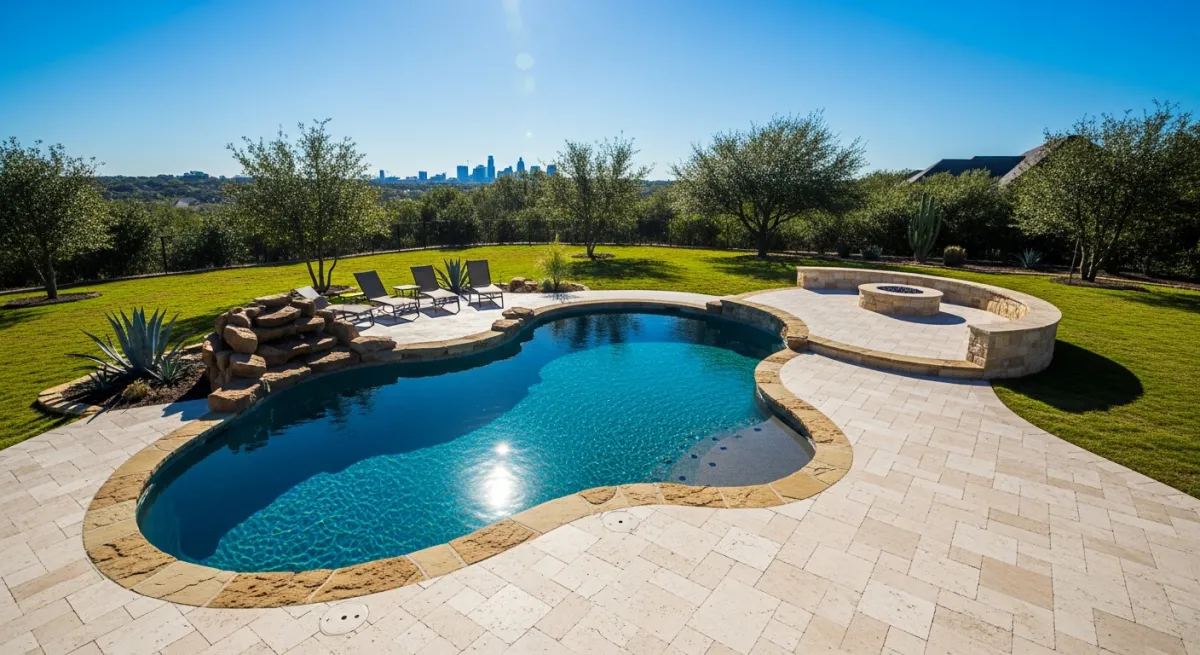
A standard inground gunite pool in Austin in 2026 costs $65,000 to $85,000 for a basic build — shell, plaster, decking, equipment, and permits — assuming your lot is straightforward and your yard doesn’t have limestone two feet down. Add a spa, sun shelf, and upgraded finish and you’re looking at $100,000 to $140,000. A fully custom pool with water features, premium coping, and an outdoor kitchen surround runs $175,000 to $250,000 and beyond. Fiberglass, which has real tradeoffs alongside its advantages, starts around $55,000 to $80,000 installed.
Those numbers are roughly double the figures you’ll find on national pool-cost sites. Those sites quote $35,000 to $65,000, and they’re largely drawing on labor and land conditions in the Midwest and Southeast, not Central Texas. Austin’s pool market is different for three reasons that don’t cancel out. A tight contractor labor supply. Material costs that absorbed a significant tariff hit heading into 2025 and haven’t come back down. And a geological reality that has no equivalent in most American suburbs: you may literally be digging through rock.
Here’s what goes into that number, and what your contractor’s initial quote almost certainly leaves out.
The City of Austin Permit Process
Building a pool in Austin requires working through the Development Services Department, and if you haven’t done this before, the calendar implications tend to hit people hard.
There are two steps that both take real time. First, DSD confirms that your proposed pool and deck don’t push your lot past its allowed impervious cover limit before they’ll accept a building permit application. This exists because Austin’s Land Development Code treats pools as a genuine land-use question, not a permitting formality — and it catches projects early that have already maxed out their coverage. Once that clears, you file the building permit with separate sub-permits for electrical and plumbing. Each gets routed through its own review queue.
Permit fees for a residential pool project run approximately $800 to $1,500 total. That covers the building permit, electrical sub-permit, plumbing sub-permit, and the pool barrier inspection fee required under IRC Chapter 305. Verify current fees directly with DSD at austintexas.gov or by calling 512-978-4000. The fee schedule gets updated periodically and the number I just gave you could be wrong by the time you’re reading this.
DSD offers an expedited review option for an additional $300 to $500. If your contractor’s schedule depends on a specific start date, price it. The processing time question matters more than the fee question: DSD’s residential review window has historically run four to eight weeks under normal conditions. In summer 2026, with seasonal project volume at its peak, plan for the longer end and possibly beyond it.
Homeowners who want a pool finished before July 4th and are starting the permit conversation in April are already behind. That’s before you factor in contractor scheduling, which is entirely separate. Want to swim in your new pool this summer? The permit application should be at DSD by February. March is workable if your contractor knows the system and your lot is uncomplicated. April is optimistic. May means you’re building a fall project whether you intended to or not.
One more layer for homeowners in master-planned communities: HOA design review in Steiner Ranch, Avery Ranch, Circle C Ranch, and Rough Hollow can run 30 to 90 days before you can even submit to DSD. That process happens first, runs in parallel with nothing, and eats real calendar time. I’ve heard from homeowners who didn’t find this out until they were already three weeks into working with a contractor. Don’t be that person.
The Impervious Cover Problem
Austin’s Land Development Code caps how much of a residential lot can be covered by impervious surfaces. Roofs, driveways, patios, pools — all of it counts. In standard SF-2 and SF-3 zoning, which covers most of Austin’s single-family neighborhoods, that cap is 45% of the lot area.
The catch: both the pool water surface and the surrounding deck count toward that 45%. On a smaller or already-developed lot in Hyde Park, Bouldin Creek, or Travis Heights — where homes often sit on 5,000 to 7,000 square feet with the house footprint, driveway, and existing patios already eating into the calculation — there may not be enough room in the numbers to fit the pool and deck combination you’re imagining. Sometimes a smaller pool or a permeable deck treatment solves it. Sometimes the lot simply can’t support the project, and you find that out only after paying for a design and waiting through DSD review. That’s an expensive and demoralizing way to learn it.
The constraints are tighter still in Waterfront Overlay zones along Lake Austin, where impervious cover limits can fall to 15% to 25% depending on the specific overlay tier. This complicates pool projects in some of Austin’s highest-value neighborhoods in ways that don’t announce themselves until you’re deep in the process. If your property falls in a WO zone, find out before you talk to a contractor.
What’s Under Your Yard
Austin’s geology is the single biggest source of surprise costs in pool construction, and the variation across a few miles of distance is something that genuinely catches people off guard if they’ve never built anything here before.
North and Northeast Austin — Pflugerville, Manor, the Round Rock fringe — sits on expansive black clay. Clay doesn’t mean cheap excavation; it means a different engineering problem. Clay expands and contracts seasonally, and a pool shell that isn’t properly engineered for it can shift, crack, or float when hydrostatic pressure builds during wet conditions. Pools on these sites typically need French drain systems around the shell, engineered backfill specifications, and reinforced slab design. These add cost that doesn’t show up in any finished product and that some contractors’ initial bids quietly omit.
West Austin, Westlake, Barton Hills, and the 78746 and 78739 zip codes sit on the Edwards Plateau. Limestone bedrock appears at or near the surface. Excavating through it requires hydraulic rock hammer equipment that standard excavators don’t carry, and in some cases you need controlled blasting when ledges are thick. This is a real line item — $5,000 to $20,000 over base excavation cost, depending on how deep the ledge runs and how much of the pool footprint it covers. Contractors who build regularly out here know to price this in. Contractors who don’t build out here regularly sometimes don’t, and the homeowner absorbs the variance as a change order after the backhoe is already in the yard.
Central Austin is mixed and unpredictable. Soil conditions in older neighborhoods can shift meaningfully from one block to the next, or within a single lot. The practical answer is a test bore before any contract is finalized — a soil investigation that tells you what’s actually there before you’ve committed to a number.
Any Austin contractor unwilling to include a rock clause in their contract is a red flag specific to this market. A rock clause explicitly defines what happens if rock is encountered during excavation — who pays, how much, under what process. This is not a standard ask in most American cities. In Austin, it’s basic due diligence.
Full Cost Breakdown
A few line items appear inconsistently in contractor quotes and account for most of the budget surprises worth flagging. As we note in our home & property coverage, outdoor improvements in Central Texas carry site-specific costs that national estimates routinely miss.
Rock removal runs $5,000 to $20,000 depending on limestone depth and extent. High probability in west Austin, Westlake, Barton Hills, and Circle C; meaningful probability across central Austin. You need a rock clause in the contract to handle this without a blowup.
Interior finish upgrades — pebble or quartz over standard white plaster — add $3,000 to $6,000. Austin’s UV intensity and water chemistry are hard on standard plaster. The upgrade extends the resurfacing interval significantly. On a pool you’re spending $75,000 to build, it’s easy money to justify.
Decking varies by material: brushed concrete runs $8 to $12 per square foot, travertine pavers $18 to $28, spray or cool deck $6 to $9, all reflecting Austin labor costs. Your choice here shapes both the immediate bill and the maintenance burden for the life of the pool. If you’ve ever walked barefoot on dark concrete in August, you already understand why the cool deck premium is easy to rationalize.
Heritage Tree protection fencing costs $500 to $2,000 and is required under Austin’s Heritage Tree Ordinance for any protected tree whose critical root zone overlaps the construction site. Protected trees are generally oaks 19 inches in trunk diameter and larger. Fencing goes in before excavation starts and stays up throughout the project. This is a city enforcement matter, not a suggestion.
Freeze protection automation runs $500 to $1,500. After February 2021, any contractor still installing Austin pools without automatic freeze protection equipment is behind current practice. Full stop. The system pays for itself on a single freeze event — anyone who lived through Uri doesn’t need that math explained.
Get itemized bids, not lump sums. You need to see where each of these lands in each contractor’s number, not just the total.
What the Pool Adds to Your Monthly Bills
Filling an 18,000-gallon pool from city supply pushes your billing deep into Austin Water’s Tier 3 and Tier 4 rate brackets. The one-time fill cost runs approximately $150 to $250 depending on your base usage in the same billing period. Verify current tier rates at austinwater.org — Council adjusts them periodically. The tier structure means every gallon above your normal baseline gets priced at the higher rate, which is how a pool fill produces a triple-digit bill surprise for first-time pool owners. Not a rounding error. An actual shock.
The local workaround that experienced Austin pool owners know: water truck delivery. A residential delivery runs approximately $200 to $350 total for a standard fill and bypasses Austin Water’s tier escalation entirely because it doesn’t run through your city meter. For a new fill, trucked water is often cost-neutral or slightly cheaper. Many Austin pool service companies routinely recommend it. And yet a lot of first-time pool owners still find out about it after they’ve already seen the bill.
Austin summers lose one to two inches of pool water per week from evaporation alone, and that number runs high during the sustained 100-plus-degree stretches that have become routine in late July and August. Across a full year, expect makeup water needs of roughly 15,000 to 25,000 gallons annually from evaporation, plus more from filter backwash cycles. A pool cover reduces this substantially. The economics of covers are more favorable here than in most markets precisely because evaporation is so aggressive.
Single-speed pool pumps run approximately $150 to $175 per year in electricity at current Austin Energy rates. New pool installations in Texas are now required under state energy code to use variable-speed pumps, which run at lower speeds for routine circulation and ramp up only for cleaning cycles — bringing annual operating costs down to roughly $50 to $85 per year. Verify the current residential rate at austinenergy.com; the fuel adjustment clause changes monthly.
Austin Energy’s Value Time-of-Use rate offers a further reduction for customers willing to schedule pump operation during off-peak hours. Running your pump primarily in the early morning rather than afternoon peak periods reduces the effective rate per kilowatt-hour. This requires a programmable controller on the pump timer, which any competent pool builder in Austin should be setting up as standard practice.
Austin Energy has offered a variable-speed pump rebate program in recent years. Check current 2026 availability directly at austinenergy.com/rebates before your equipment purchase — rebate programs run on funding cycles and aren’t always well-advertised.
The Drought Variable Nobody Puts in the Contract
Austin Water operates under a tiered drought contingency plan. At Stage 2 — a restriction level that has been triggered in recent summers during extended dry periods — residential pool filling from city supply can be restricted or banned entirely. That means a finished pool, structural work done and decking laid, can legally sit empty for weeks while a homeowner waits for the city to ease restrictions.
This is a real planning variable. Water truck supply can also tighten during city-wide drought restrictions because demand spikes across the entire pool-owning population at once. If your pool is scheduled to be filled in July or August — Austin’s highest drought-risk window historically — you need a plan that doesn’t depend entirely on either city supply or immediate truck availability.
No standard pool construction contract addresses this because it’s outside the contractor’s control. But it belongs in your planning timeline. Any contractor who presents a guaranteed summer completion without flagging it is giving you an incomplete picture of how Austin projects actually finish.
The Austin ROI Case, Honestly Assessed
Austin’s pool season runs approximately 300 days per year. That’s more than double the usable season in most northern markets. A pool that costs $100,000 but gets used heavily for nine months a year is a different financial proposition than the same pool somewhere with a four-month season — and that comparison is worth making before you write the check.
The property value question is messier. In Westlake and Tarrytown, a pool is expected at the price tier. Its absence can be a negotiating point against a seller in competitive listings. In master-planned suburban communities like Steiner Ranch and Avery Ranch, pools are common enough to be table stakes — they help maintain market position but rarely produce a meaningful premium. On urban infill lots in central neighborhoods, where the house footprint already strains impervious cover limits, a pool’s contribution to resale value is the least predictable outcome in this whole conversation. For a fuller picture of what home improvements actually add resale value in Central Texas, the calculus varies significantly by project type and neighborhood.
What I would count on: the carrying costs are real and belong in the financial model. Water, electricity, chemicals, and professional service visits. Don’t let a contractor’s sales materials skip past those numbers.
How to Hire a Licensed Pool Contractor in Austin
Texas pool contractors are required to hold a license through the Texas State Board of Plumbing Examiners. The license database is publicly searchable on the TSPB website. Verify the license is current and in good standing before you sign anything. This is a five-minute check. A surprising number of buyers skip it. Don’t.
The optimal build window in Austin is September through February. Contractor availability is better, DSD permit queues are shorter, and you’re building during weather that’s easier on both crew and materials. Some Austin pool builders price compressed summer start timelines at a 5% to 10% premium, because they’re paying for overtime and scheduling into an already-packed season. Starting in fall to swim the following May is not a consolation prize. It’s the rational move.
Four contract provisions that Austin buyers specifically need to require:
A rock clause that defines what happens if rock is encountered during excavation — who pays, how much, under what process. In west Austin and Barton Hills, hitting limestone is close to a certainty. A lump-sum bid with no rock clause is a contract built to produce change orders after the backhoe is already in your yard.
A test bore provision on central or west Austin sites. Costs a few hundred dollars. Eliminates the single biggest source of overruns in this market. Contractors who resist this have a reason for resisting it.
Freeze protection automation as a specified line item — not implied, not mentioned in passing, but named in the contract with the specific equipment to be installed.
Itemized cost breakdowns. A lump-sum bid tells you a total. It doesn’t tell you where the overruns will land if the project hits complications, and it makes it nearly impossible to compare two bids with any intelligence. Itemized bids let you see where you’re getting good value and where you’re being priced aggressively, and they give you something concrete to cut if the number needs to come down.
Get bids from at least three licensed contractors and be skeptical of the low outlier. In a market where geology can add $20,000 to an excavation cost without warning, a bid that comes in 20% below the other two is more likely incomplete than a bargain. That’s not cynicism about contractors generally — it’s a specific fact about how Austin soil works.
The pool you’re imagining is probably buildable. The 300-day season is real, and there are excellent contractors working in this market. But Austin pool projects fail the homeowner’s budget in predictable, avoidable ways: starting too late for summer permits, signing contracts with no rock clause in limestone country, not understanding the impervious cover cap before paying for a design. None of those are mysteries. They’re just information you need before you sign anything.