How Austin's Three Property Tax Caps Work and What Each One Actually Does to Your Bill
TCAD appraises your home at one value, taxes you on another, and the state just added a third layer. A Travis County homeowner's real bill shows how it works—and where the protection runs out.

TCAD appraises your home at one value, taxes you on another, and the state just added a third layer. A Travis County homeowner’s real bill shows how it works—and where the protection runs out.
Most Austin homeowners who call their property tax consultant in a panic have the same complaint: “They told me I was protected by the cap.” The problem is that “the cap” can mean three entirely different things depending on who said it and when. A 1997 law limits how fast your taxable value grows. A 2019 law limits how fast governments can grow their revenue. A 2023 ballot measure changed your school tax exemption and compressed Austin ISD’s rate. All three are simultaneously in effect on every homestead bill in Travis County. None of them does what most homeowners assume.
“I talk to people every week who believe the appraisal cap means their tax bill can only go up 10 percent a year,” said a consultant at Austin-based Resolute Tax & Protest. “That is not what the law says, and the gap between what they believe and what actually happened is often several hundred dollars.”
That gap is what this piece is about. Here’s what actually happened, and how to read your own bill to see which layer moved your number.
The Original Cap, Circa 1997: What Texas Tax Code §23.23 Actually Limits
Under Texas Tax Code §23.23, the assessed taxable value of a qualified homestead property cannot increase by more than 10 percent per year over the prior year’s assessed value—no matter what Travis Central Appraisal District determines your home is actually worth on the open market. Texas has had this rule since 1997. Most homeowners have heard of it. Far fewer understand what it actually constrains.
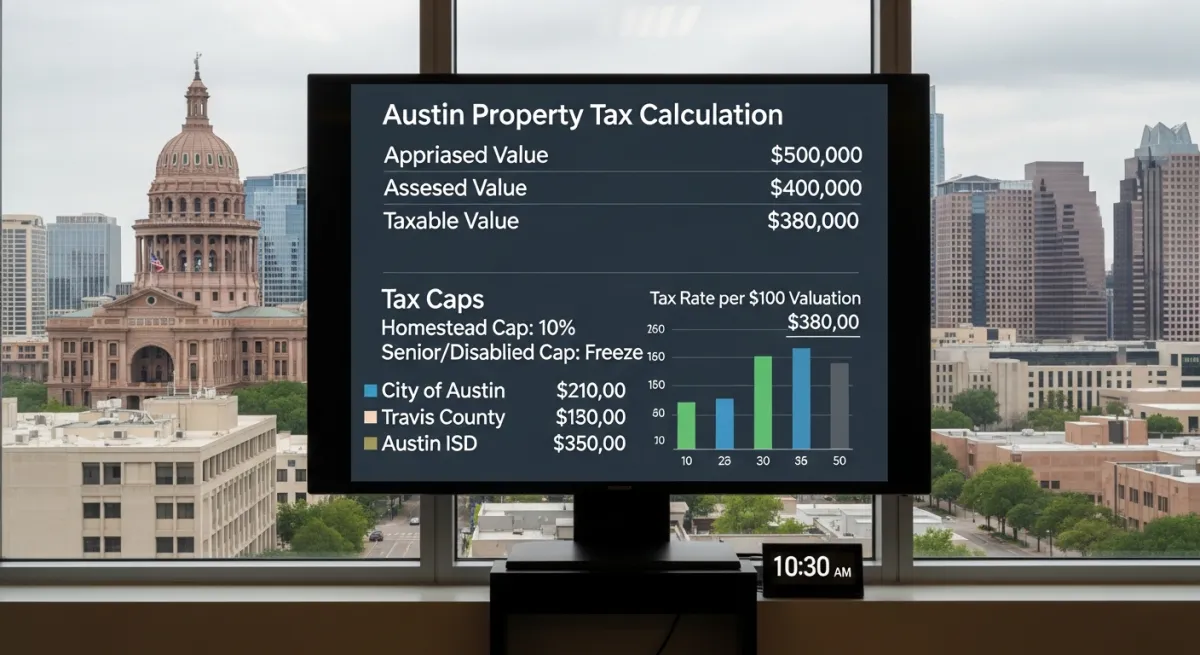
Your TCAD Notice of Appraised Value contains two separate numbers. The first line—“Appraised Value”—reflects TCAD’s estimate of what your home would sell for. The second line, “Assessed Value,” is the number used to calculate your tax bill. In years of rapid appreciation, they can be dramatically different. Two numbers. One matters to your wallet.
In a neighborhood like East Austin’s 78702 zip code—among the fastest-appreciating areas in the city between 2018 and 2023—a homeowner who bought several years ago and filed a homestead exemption could have seen TCAD’s market appraisal climb sharply while their taxable assessed value grew much more slowly. That gap can widen fast in a hot market. It can also narrow quickly when prices soften, because if TCAD’s appraisal drops below the prior assessed value, the assessed value falls too. The cap only constrains upward movement.
Here’s the piece nobody emphasizes enough: the cap applies only to qualified homestead properties—a home you own, occupy as your primary residence, and for which you have filed a homestead exemption with TCAD. It does not apply automatically. If you bought a home, moved in, and never filed the exemption form—more common than you’d think—you’ve been paying taxes on full appraised value every year. Every year. With no cap. The full scope of what the Travis County homestead exemption covers and saves you is worth understanding before your next tax cycle.
The First “SB 2” (2019): A Revenue Cap, Not an Appraisal Cap
In 2019, the Texas Legislature passed Senate Bill 2, the “Texas Property Tax Reform and Transparency Act.” This is the law most people are thinking of when they say “SB 2.” It has almost nothing to do with your individual appraisal.
What it did was lower the voter-approval tax rate threshold—the rate increase beyond which a taxing entity must hold a public election—from 8 percent to 3.5 percent for cities and counties. School districts were already held to 2.5 percent. This constrains government revenue growth, not what TCAD decides your house is worth.
If the City of Austin or Travis County wants to adopt a tax rate generating more than 3.5 percent additional revenue over the prior year, officials have to put it to voters. This has had real consequences for Austin’s budget conversations. The city has operated near that ceiling in multiple recent years, forcing city council into uncomfortable tradeoffs between service levels and rate adjustments. Those debates you’ve followed in the Austin Monitor and Austin American-Statesman? That ceiling is often why they’re happening.
But the voter-approval threshold doesn’t put a ceiling on your individual bill. If the total assessed value of every property in the city rises because Austin’s real estate market ran hot, the same tax rate generates more revenue without triggering an election. Governments can stay under the 3.5 percent growth threshold while your individual bill still climbs, because your property’s value grew faster than the citywide average. The 2019 SB 2 constrains how fast a government can grow its total revenue haul. It says nothing about how high an individual homeowner’s bill can go. Those are two different mechanisms doing two different jobs, and conflating them is the most common error in how Austin homeowners read their bills.
The 2023 Relief Package: What Proposition 4 Actually Changed
In November 2023, Texas voters approved Proposition 4. Three changes came with it, and they work differently enough that they deserve separate treatment.
The school homestead exemption increased from $40,000 to $100,000. This exemption reduces your home’s taxable value for Austin ISD purposes before the school district applies its rate. On a home with a TCAD assessed value of $500,000, the $100,000 exemption means Austin ISD taxes you on $400,000, not $500,000. For homeowners in Austin’s middle price range, this was the most tangible piece of the entire 2023 package. The additional $60,000 exemption translates to real school tax savings at prevailing rates for anyone in the $400,000–$600,000 assessed-value range.
School district Maintenance and Operations rates also declined. The state used increased school finance funding to allow—and in some cases require—districts to lower their M&O rates. Austin ISD’s M&O rate was reduced as a result. The Travis County Tax Office’s rate sheets for tax year 2023 reflect the compressed rate. Confirm Austin ISD’s current adopted rate directly at austinisd.org or tax.traviscountytx.gov; the specific figure needs verification against AISD’s adopted budget documents before you rely on any calculation.
A third provision got far less press coverage. Proposition 4 created a new 20 percent annual appraisal cap on non-homestead commercial properties valued under $5 million. Before 2023, commercial properties absorbed full market appraisal every year with no cap whatsoever. Now a small apartment building or commercial storefront below the threshold is protected from assessed-value increases exceeding 20 percent annually. It doesn’t apply automatically—the property must meet specific use and value criteria—and it resets on sale, just like the homestead cap.
A Real Travis County Bill: One East Austin Home, Three Layers Applied
To see how all three interact, consider this scenario built around the framework Travis County tax professionals use, with actual 2023 rates where verified.
The property: a home in the 78702 zip code, purchased in 2019 for approximately $380,000. Homestead exemption filed. TCAD’s 2023 appraised market value: $610,000. Because of the §23.23 cap applied each year since purchase, the prior-year assessed value was approximately $460,000. With a 10 percent cap applied, the 2023 assessed value is $506,000.
Stop there for a second. That’s $610,000 in market value versus $506,000 in taxable value. The $104,000 difference is the accumulated cap benefit doing actual work.
Austin ISD calculates school tax against $506,000 assessed value minus the $100,000 exemption—$406,000 taxable for school purposes. The exact school tax bill depends on Austin ISD’s adopted 2023 combined rate, which readers should verify at tax.traviscountytx.gov. What’s clear regardless of the rate: the $100,000 exemption is a $60,000 improvement over the prior $40,000 exemption, shrinking the taxable base for school purposes by an additional $60,000. School taxes represent the largest single line on most Austin homestead bills, so this is where the Prop 4 relief is most visible.
The City of Austin’s 2023 adopted rate was approximately $0.5410 per $100 of assessed value. On an assessed value of $506,000—versus the full market appraisal of $610,000—the §23.23 cap is reducing the city’s taxable base by $104,000. Travis County’s 2023 rate was approximately $0.3130 per $100, and the same logic applies there.
If you’re in a Municipal Utility District out in the Pflugerville or Cedar Park fringes, you already know how those extra lines stack up. The Travis County Tax Office publishes a full rate sheet for all overlapping jurisdictions at tax.traviscountytx.gov; searching your property address there gives you the complete picture for your parcel.
Without the §23.23 cap, school taxes on this property would be calculated against $610,000 minus $100,000, or $510,000—compared to $406,000 with the cap in place. Without the 2023 exemption increase, the taxable base would be higher still. Each layer compounds. That’s the part that rarely gets explained in plain language.
What the Cap Does Not Cover
The §23.23 homestead appraisal cap applies only to homestead properties. If you own a rental in 78704, a duplex near South Congress, or a short-term rental you list on Airbnb but don’t occupy as your primary residence, the 10 percent annual cap doesn’t apply. Those properties absorb full TCAD market appraisal every year. For investment properties in Austin’s hottest zip codes, that meant significant single-year assessed-value jumps in 2021 and 2022—jumps a homestead owner in the same neighborhood was at least partially shielded from.
The new 20 percent commercial cap from Prop 4 provides some relief for smaller investment properties, but it’s not a substitute for the homestead cap and only covers non-homestead properties valued below $5 million.
New construction introduces another carve-out that trips up buyers regularly. The §23.23 cap doesn’t apply in the first year a property is appraised after construction or after a change of ownership. If you bought a newly built home in the Mueller development in 2021 or 2022, at the top of Austin’s market, you had no cap protection in your first tax cycle. Your first bill was calculated on whatever TCAD appraised your new home for, full stop. The cap begins applying in the second year, based on that first appraised value. Plenty of Mueller buyers who closed in 2019 through 2022 were caught off-guard by that first bill. It’s a known exposure that new construction buyers need to plan around.
When a Home Sells, the Cap Resets
This one catches buyers off guard more than anything else. When a homestead property changes hands, the new owner’s assessed value resets to full TCAD market value in the first tax year. The prior owner’s accumulated cap benefit—sometimes tens of thousands of dollars in reduced taxable value—does not transfer. Gone.
Austin’s median home value softened from a 2022 peak of around $667,000 to somewhere in the low-to-mid $500,000s by late 2024. A buyer who purchased near that peak may have found TCAD’s subsequent appraisal close to or above their purchase price, with no cap protection in year one. Their cap benefit starts building from that first appraised value and accumulates forward—but the prior owner’s cushion is gone entirely.
In some cases, buyers who purchased at 2022 peak prices have found TCAD’s current appraisal has actually retreated below what they paid. That’s useful for protest purposes, but it doesn’t mean the cap is providing any shelter. They start fresh, and the benefit builds from year one. For a broader look at how values are shifting across neighborhoods, our home prices by zip code analysis for 2026 tracks which parts of Austin are still sliding and which have stabilized.
Can the City Still Raise Your Bill Even With a Capped Appraisal?
Yes.
This is the misconception that generates the most frustration among homeowners who felt protected and then weren’t.
The appraisal cap and the voter-approval rate threshold operate on opposite sides of the tax equation: Value × Rate = Tax Owed. The §23.23 cap controls the value side. The 2019 SB 2 constrains how fast a government can grow total revenue, but it doesn’t freeze the rate itself. If Austin City Council adopts a tax rate increase up to the voter-approval ceiling, and your capped assessed value is lower than your neighbor’s uncapped investment property, you still pay more than last year—because the rate moved. The cap reduced the dollar amount of the increase. It didn’t eliminate the increase.
And the reverse is also true: even in a year when governments held rates flat, a homeowner whose cap had been absorbing years of appreciation saw their assessed value move somewhat toward market value. Their bill rose with no rate change at all.
Reading your tax bill means looking at two separate lines: what did your assessed value do year-over-year, and what did the adopted rate for each jurisdiction do year-over-year? If both moved up, your bill is getting squeezed from both sides simultaneously. The cap is not a guarantee against increases. It’s a floor on one of two variables.
What to Do Before the May 15 Protest Deadline
The Travis County protest deadline is May 15, or 30 days after TCAD mails your Notice of Appraised Value, whichever is later. Notices go out in April. If you haven’t seen yours and it’s past April 1, check your TCAD account at tcad.org—notices are posted there electronically. Don’t wait for the paper copy if you’re cutting it close.
Verify the cap was applied correctly. Open your notice and compare the “Appraised Value” line to the “Assessed Value” line. If they’re identical and you’ve owned the home for more than one year with a homestead exemption on file, something may be wrong. Common errors include TCAD not having your exemption correctly recorded—particularly for homes that changed owners in 2021 or 2022 and where the exemption form was filed late—or data entry errors after new construction or remodeling.
File a protest if TCAD’s market appraisal appears above actual market value. You’re protesting the appraised value, not the assessed value directly, but that’s what determines the assessed value. TCAD accepts protests online at tcad.org, by mail, or in person at 850 E. Anderson Lane, north of the Domain. Check “value is over market value” and, if applicable, “value is unequal compared with other properties.” TCAD accepts sales comparables, independent appraisals, and evidence of property condition as supporting material. For the 2023 and 2024 cycles, a significant number of Austin properties—particularly those appraised at 2022 peak values—have had successful protests on the strength of recent sold comparables from the same neighborhood showing lower transaction prices. That database is public. Use it.
On whether to hire a protest firm: Austin has a well-developed property tax protest industry. Firms including Texas Protax and Resolute Tax & Protest work primarily on contingency—a percentage of your first year’s savings if the protest succeeds, nothing if it doesn’t. For homeowners who don’t want to spend a Saturday morning at TCAD or aren’t comfortable pulling comparable sales from public records, a contingency-fee firm is a reasonable choice. For homeowners willing to do the work themselves, TCAD’s property search database is public and searchable by neighborhood and sale date; a self-filed protest is straightforward if you have an hour and a decent set of comps. The contingency firms earn their cut. They’re also not necessary if you’re organized and the evidence is clear-cut. More detail on the full process is in our coverage of how to protest your Travis County property tax appraisal in our home & property coverage.
Finally, confirm your homestead exemption is on file. Log in to tcad.org and search your property address to verify it’s recorded. Miss the filing deadline and you wait another full year—paying taxes on the uncapped value in the meantime, with no recourse.
Texas has a property tax cap. It actually has three of them, layered on top of each other, each one constraining a different number in the calculation. Understanding which lever you actually control—and which levers your city council or school board can still pull in the other direction—is the difference between a surprise bill and an expected one. The math is not complicated once you know what each line means. Most homeowners just never had anyone explain it to them straight.
Rates cited reflect 2023 adopted tax year rates as published by the Travis County Tax Office where verified. Confirm current rates, assessed values, and exemption status on your individual TCAD notice and at tax.traviscountytx.gov. Austin ISD’s adopted M&O rate for tax years 2023 and 2024 should be confirmed directly with AISD or the Travis County Tax Office before relying on any calculation. Protest deadline dates are set annually by TCAD; confirm the current year’s deadline at tcad.org.